
Thread smart devices have quietly become the most reliable option for buyers who want a home automation setup that works without constant troubleshooting – no cloud outages, no Wi-Fi congestion eating into response times. The picks worth your attention right now include the ONVIS Matter+Thread Smart Plug 15A 4-Pack for whole-home coverage, the ONVIS Matter Thread Smart Plug 15A No-Cloud for buyers who want local control only, and the ULTRALOQ Bolt SE for door security on the Thread network. This guide breaks down exactly who each one is built for, where each falls short, and which is worth your money.
Quick Comparison
| # | Product | Key Features | Score | |
|---|---|---|---|---|
| 1 |
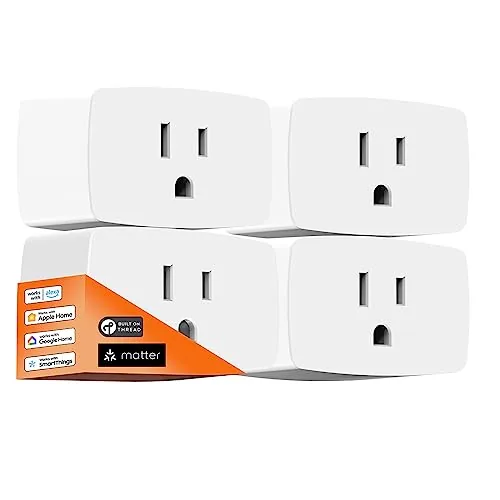 ONVIS Matter+Thread Smart Plug 15A 4-Pack
|
|
8.5 ★★★★☆ | Check Price on Amazon Read full review ↓ |
| 2 |
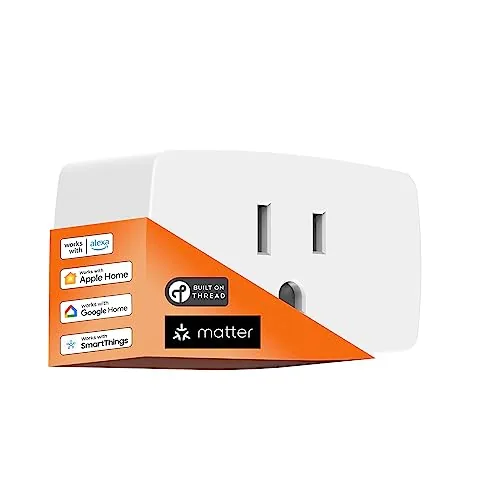 ONVIS Matter Thread Smart Plug 15A No-Cloud
|
|
8.5 ★★★★☆ | Check Price on Amazon Read full review ↓ |
| 3 |
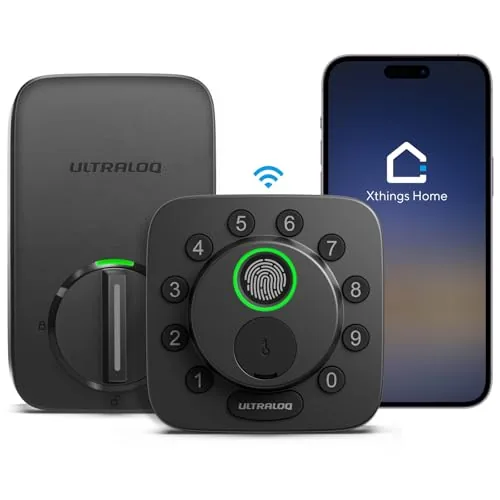 ULTRALOQ Bolt SE Wi-Fi Smart Lock with Matter
|
|
8.3 ★★★★☆ | Check Price on Amazon Read full review ↓ |
| 4 |
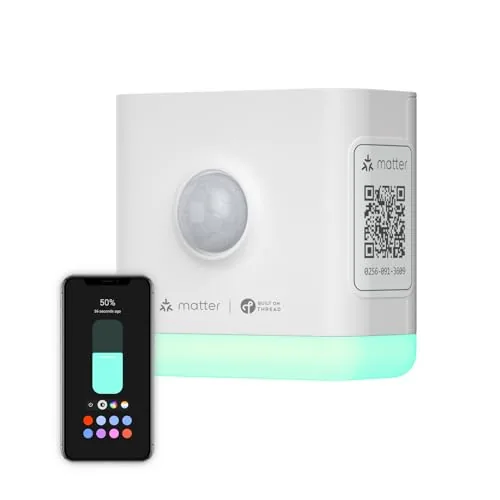 THIRDREALITY Smart Night Light Matter over Thread RGB
|
|
8.2 ★★★★☆ | Check Price on Amazon Read full review ↓ |
| 5 |
 Onvis Matter over Thread Smart Plug with Energy Monitoring
|
|
8.2 ★★★★☆ | Check Price on Amazon Read full review ↓ |
| 6 |
 Aqara P2 Door & Window Sensor with Matter/Thread
|
|
8.2 ★★★★☆ | Check Price on Amazon Read full review ↓ |
| 7 |
 Aqara Hub M100 Matter Bridge with Zigbee and Thread
|
|
8.2 ★★★★☆ | Check Price on Amazon Read full review ↓ |
| 8 |
 Onvis Smart Plug Matter Thread Energy Monitor 4-Pack
|
|
8.2 ★★★★☆ | Check Price on Amazon Read full review ↓ |
| 9 |
 Onvis Outdoor Smart Plug Matter over Thread IP65
|
|
7.8 ★★★★☆ | Check Price on Amazon Read full review ↓ |
These plugs use Matter over Thread for local-only control, meaning no cloud account, no data collection, and no internet required once set up on your local network. At $13.25 per plug, you get 15A capacity and a profile narrow enough to leave the adjacent outlet free. Setup works directly through Apple Home, Alexa, Google Home, or SmartThings without a separate hub if you have a Thread border router like a HomePod mini or Apple TV 4K.
Key Features
- Matter-certified, compatible with Apple Home, Alexa, Google Home, SmartThings
- Thread protocol keeps devices responsive on local network without internet
- Compact body leaves adjacent outlet unblocked, two fit one outlet
- App and voice control for switching and scheduling connected devices
- Set on/off schedules and countdown timers per device
- No cloud, no account, no data tracking, fully local operation
- Group multiple plugs and share access with household members
✅ Pros
- No cloud dependency means devices still respond during internet outages
- 15A/1800W rating handles most appliances including space heaters and window AC units
- Compact form factor lets you use both outlets on a duplex receptacle
- Works across all four major smart home platforms without a separate bridge
- Full privacy with zero data collection or account registration required
❌ Cons
- Remote access outside the home requires a HomePod mini or Apple TV acting as a Thread border router
- Thread border router requirement adds a hidden cost for users who do not already own one
Why We Chose It
The combination of Matter certification and Thread networking sets these apart from Wi-Fi plugs that rely entirely on cloud servers. Local processing keeps response times low and keeps the plugs functional during outages. The no-account privacy model is rare at this price point.
Perfect For
Apple Home users who already own a HomePod mini or Apple TV and want reliable, private smart plugs that work across multiple platforms.
A 15A Matter-certified smart plug that runs entirely on your local network, requiring no cloud account or registration. Thread support cuts response latency compared to Wi-Fi-only plugs, provided you have a HomePod mini or Apple TV acting as a border router. At $17.99 with full cross-platform support, it undercuts most Matter plugs without sacrificing compatibility.
Key Features
- Certified Matter device works across all major smart home platforms
- Thread protocol delivers faster, lower-latency local control
- Voice control via Alexa, Google Assistant, and Siri
- Schedule and timer automation for on/off routines
- Compact body fits two plugs side by side in one outlet
- No cloud, no account, no data tracking, fully local operation
- Group multiple plugs and share access with household members
✅ Pros
- No cloud dependency means your automations keep working if the internet goes down
- Full Matter certification removes platform lock-in across Apple, Amazon, Google, and Samsung
- 15A/1800W rating handles most lamps, fans, and small appliances without issue
- Compact form factor does not block the second outlet on a standard duplex
❌ Cons
- Thread remote access requires a HomePod mini or Apple TV border router, adding cost for non-Apple users
- Thread advantages over standard Wi-Fi Matter plugs will not be noticeable for simple on/off use cases
Why We Chose It
Most smart plugs at this price point rely on cloud servers, meaning your automations fail if the manufacturer’s infrastructure goes down or the company shuts off support. This plug runs entirely on the local network and carries a real Matter certification, so it will work with whatever platform you use today or switch to later. The no-registration privacy model is a genuine differentiator, not a marketing claim.
Perfect For
Apple Home users who want a compact, privacy-respecting smart plug that also stays compatible if they later add Alexa or Google Home devices.
The Bolt SE gives you seven ways to unlock your door, including fingerprint, PIN, app, and voice, without needing a separate hub for basic remote access. Built-in 2.4 GHz Wi-Fi handles remote control directly, while Matter over Thread adds deeper smart home integration for those with a compatible Thread border router. At $99.99, it covers more access methods and connectivity options than most locks at this price.
Key Features
- Seven entry methods including fingerprint, PIN, app, voice, and key
- Built-in Wi-Fi remote access without a hub, 2.4 GHz only
- Matter over Thread support requires a compatible Thread border router
- Works with Apple Home, Alexa, and Google Assistant via Matter
- Thread mesh network self-heals if a connected device drops
- Claimed 18-month battery life using Thread low-energy protocol
- Auto-lock timer and instant lock button, no door sensor included
- IP65-rated zinc alloy body, ANSI BHMA certified, 10-minute install
✅ Pros
- No hub required for remote access via built-in Wi-Fi
- Stores up to 50 fingerprints and 50 PIN codes with activity logs
- Matter over Thread future-proofs it for broader smart home ecosystems
- IP65 weather resistance makes it viable for exterior doors in harsh climates
- Two mechanical keys retained as a backup entry method
❌ Cons
- Matter features require a separate Thread border router not included
- Wi-Fi limited to 2.4 GHz and router must be within 70 feet of the lock
Why We Chose It
Most sub-$100 smart locks force you to choose between hub-based remote access or built-in Wi-Fi. The Bolt SE includes both, giving you reliable standalone remote control now and a path into Matter ecosystems later. The 18-month battery claim and IP65 rating add practical durability that justifies the price for an exterior front door.
Perfect For
Homeowners who want keyless entry with immediate remote access and plan to expand into a Matter-compatible smart home over time.
A plug-in night light that combines RGB color output, a motion sensor, and an illuminance sensor in one unit. It runs on Matter over Thread, which keeps latency low and avoids Wi-Fi congestion. Compatible with Home Assistant, Apple Home, Alexa, Google Home, and Homey without requiring a separate branded hub beyond a Thread border router.
Key Features
- Matter over Thread certified for low-latency, low-power connectivity
- Combines RGB light, motion sensor, and illuminance sensor in one device
- Supports smart routines with compatible devices like garage door openers
- RGB color selection with brightness adjustable from 1 to 100 percent
- OTA firmware updates available through the 3R-Installer companion app
✅ Pros
- Matter over Thread means broad platform compatibility without Wi-Fi dependency
- Three sensors in one device reduces clutter in hallways and bedrooms
- 1 to 100 percent brightness range covers both ambient and functional lighting
- Works locally with Home Assistant, useful if cloud reliability matters to you
❌ Cons
- Requires a Thread border router already in your setup, adding cost if you lack one
- 3R-Installer app adds an extra step for firmware updates outside your main smart home app
Why We Chose It
Most RGB night lights at this price point use Wi-Fi and lock you into one ecosystem. This one uses Thread, which cuts response lag and works across Apple Home, Google Home, Alexa, and Home Assistant simultaneously. The built-in motion and illuminance sensors make it genuinely useful for automation without buying separate sensor hardware.
Perfect For
Smart home users already running a Thread border router who want a compact, multi-platform night light with real sensor capability for hallways, nurseries, or stairways.
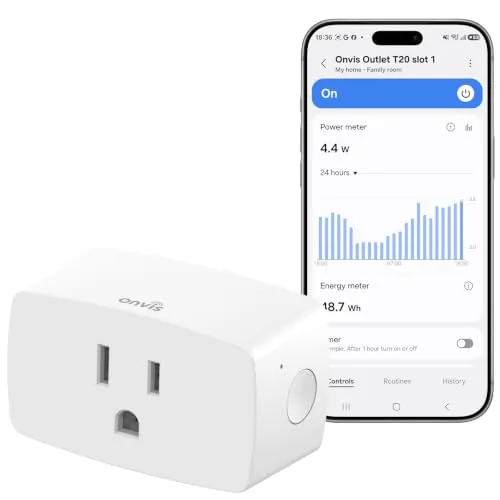
This plug runs on Thread rather than Wi-Fi, which means faster response times and fewer dropped commands in crowded wireless environments. Built-in energy monitoring tracks real-time wattage and historical usage, so you can see exactly what each appliance costs to run. At $19.99 with ETL and FCC certification, it covers safety, reliability, and modern smart home standards in one compact unit.
Key Features
- Real-time power tracking with historical usage data
- Matter over Thread protocol requires a compatible Thread Border Router
- Handles up to 15A and 1800W for common household appliances
- Schedule, timer, and automation controls via smartphone app
- Compact US plug design keeps second outlet accessible
- ETL Listed and FCC Certified for US safety standards
✅ Pros
- Thread protocol reduces latency and avoids Wi-Fi congestion
- Energy monitoring adds measurable utility beyond basic on/off control
- 15A/1800W rating handles heaters and coffee makers, not just lamps
- Works across major Matter ecosystems without vendor lock-in
❌ Cons
- Requires a Thread Border Router, which not all users already own
- Matter over Thread setup is more involved than a simple Wi-Fi plug
Why We Chose It
The combination of Thread networking and built-in energy metering puts this plug above most competitors at the same price point. Thread offers local control with lower latency than cloud-dependent Wi-Fi plugs, and the 15A rating gives it broader appliance compatibility than the typical 10A or 12A alternatives.
Perfect For
Smart home users already running a Thread Border Router who want energy visibility alongside reliable automation.
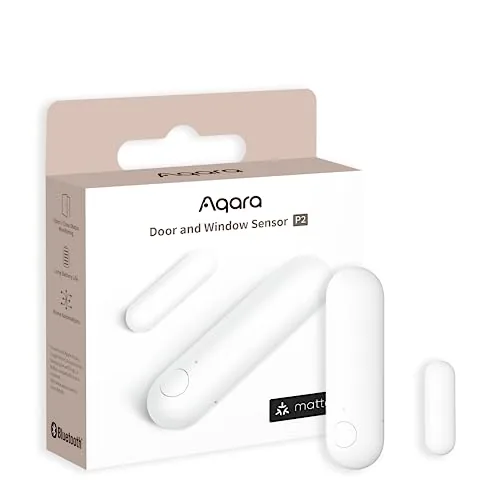
The P2 uses the Thread protocol to deliver low-latency, reliable open/close detection without depending on Wi-Fi or cloud servers. It works natively with Apple Home, Google Home, Alexa, and SmartThings, making it one of the few contact sensors that fits into any major smart home ecosystem. Local automations keep running during internet outages, which sets it apart from most sensors in this price range.
Key Features
- Native Matter over Thread support for multi-platform compatibility
- Hall sensor detects door, window, and drawer open/close states precisely
- Local automations run offline, no cloud required for execution
- Voice control via Siri, Alexa, and Google Assistant
- Tested with Apple TV 4K, Echo 4th gen, Nest Hub 2nd gen
- Adhesive mount, compact body, CR123A battery with extended life
✅ Pros
- Works with all four major ecosystems through a single Matter pairing
- Local processing keeps automations running during internet outages
- Thread protocol reduces latency and improves connection stability compared to Zigbee or Z-Wave Wi-Fi bridges
- 22mm max gap tolerance is clearly specified, removing guesswork during installation
❌ Cons
- Requires a separate Matter Controller and Thread Border Router, adding cost of at least one compatible hub
- Battery life varies depending on which border router and app you use, making estimates unreliable
Why We Chose It
The P2 is one of the few contact sensors with native Matter over Thread support, meaning it integrates directly into Apple Home, Google Home, or Alexa without proprietary bridges or workarounds. Its local automation execution is a practical advantage for anyone who wants their security triggers to work regardless of internet status.
Perfect For
Homeowners already invested in a Matter-compatible hub who want a contact sensor that works across multiple ecosystems without re-pairing or extra adapters.
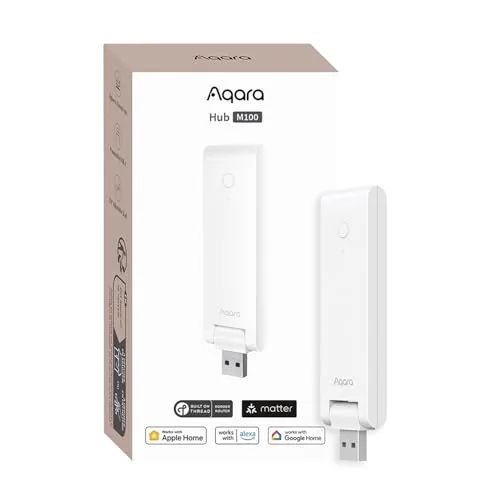
The M100 bridges Aqara Zigbee devices into Matter ecosystems like Apple Home, Alexa, and Home Assistant without requiring a separate hub. It runs automations locally, so routines execute in milliseconds even when your internet is down. At $29.99 with Wi-Fi 6 and WPA3 support, it covers serious ground for a budget hub.
Key Features
- Supports up to 20 Zigbee and 20 Thread devices simultaneously
- Acts as Matter Bridge connecting Aqara Zigbee to third-party ecosystems
- Local automation execution works without Wi-Fi or cloud access
- USB-A powered with 210-degree adjustable shaft for flexible placement
- 2.4GHz Wi-Fi 6 with WPA3 security requires placement within 19 feet of router
✅ Pros
- Local execution means automations fire in milliseconds with no cloud dependency
- Matter bridging unlocks Aqara Zigbee devices in Apple Home, Alexa, and Home Assistant
- Wi-Fi 6 with WPA3 is rare at this price point
- USB-A power input works from a router port, PC, or power bank without a dedicated outlet
❌ Cons
- Only bridges Aqara Zigbee devices, not third-party Zigbee hardware
- Power adapter not included and hub must stay continuously powered to function
Why We Chose It
The M100 earns its spot by combining Matter bridging, Thread support, and local automation execution in a sub-$30 package. Most hubs at this price either lack Matter support or force cloud-dependent automations. The 210-degree adjustable connector and USB-A power input also make physical placement genuinely flexible.
Perfect For
Aqara Zigbee device owners who want to bring their existing hardware into Apple Home, Home Assistant, or Alexa without replacing their sensors and switches.
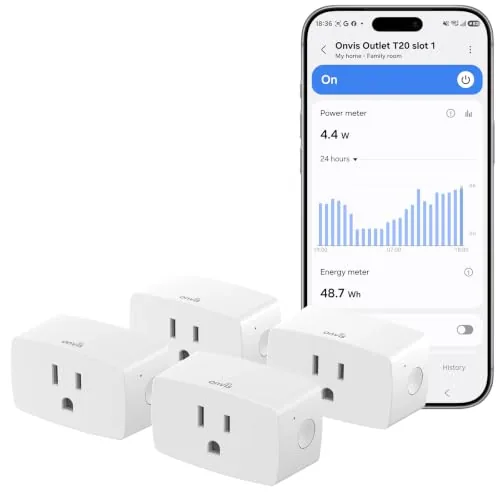
These plugs run on Matter over Thread rather than Wi-Fi, which means local control that stays fast even when your router is busy. Each plug tracks real-time wattage and cumulative consumption, so you can see exactly what a space heater or coffee maker costs to run. At $14 per plug with energy monitoring included, the per-unit price is competitive for Thread-native hardware.
Key Features
- Real-time wattage and historical energy consumption tracking built in
- Matter over Thread protocol for local, low-latency smart home control
- 15A and 1800W capacity handles heaters, fans, and coffee makers
- Schedule, timer, and automation support via app or voice
- Compact US plug body keeps second outlet accessible
- ETL Listed and FCC Certified for US safety and RF compliance
✅ Pros
- Thread mesh networking reduces Wi-Fi congestion and improves response reliability
- Energy monitoring at this price point is uncommon in Thread plugs
- 15A rating covers most mid-draw household appliances
- Matter compatibility means no vendor lock-in across Apple, Google, and Amazon ecosystems
❌ Cons
- Requires a Thread Border Router already in your setup, such as a HomePod mini or eero Pro 6E, or the plugs will not function
- Energy data and automations depend on the host ecosystem app, not a dedicated Onvis app
Why We Chose It
The combination of Thread networking and built-in energy monitoring in a single compact plug is rare at this price. Thread gives noticeably faster on/off response compared to Wi-Fi plugs, and the 15A rating means you are not limited to low-draw lamps. The four-pack format makes whole-room deployment practical without a large upfront cost per outlet.
Perfect For
Homeowners already using a Thread Border Router who want per-outlet energy tracking across multiple rooms without paying for a premium brand.
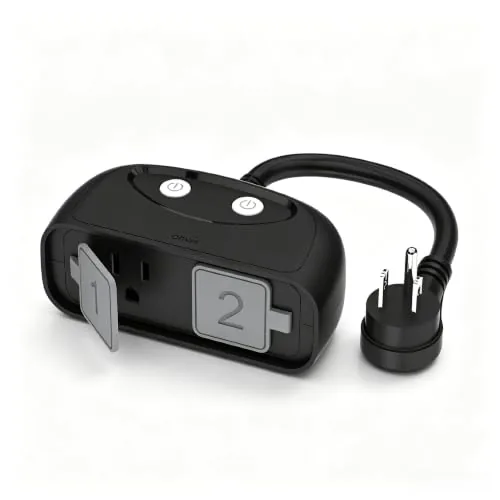
This outdoor plug runs on Matter over Thread, meaning it works natively with Apple Home, Alexa, Google Home, and SmartThings without a brand-specific hub. IP65 weather resistance handles rain and snow year-round. Real-time energy monitoring lets you track actual watt usage per device, not just on/off state.
Key Features
- Matter over Thread protocol works across four major smart home platforms
- Real-time energy monitoring tracked through your Matter-compatible app
- IP65 rated for rain and snow exposure year-round
- Voice control supported via Alexa, Google, and Apple platforms
- Scheduling and timers automate device on/off without manual input
✅ Pros
- Matter over Thread means no proprietary app or cloud lock-in
- IP65 rating is a verified standard, not a vague weather-resistant claim
- Energy monitoring at the outlet level helps identify high-draw appliances
- Compatible with four major ecosystems out of the box
❌ Cons
- Requires a Thread border router, which adds cost if you do not already own one
- Single outlet only, limiting use where multiple connections are needed
Why We Chose It
The Matter over Thread combination is rare at this price point and eliminates the ecosystem fragmentation that plagues most smart plugs. IP65 protection paired with real-time energy monitoring makes it genuinely useful for outdoor equipment like pumps or heaters where power draw actually matters.
Perfect For
Homeowners already running a Thread-capable hub who want to automate and monitor outdoor appliances across multiple smart home platforms.
Expert Verdict: ONVIS Matter+Thread Smart Plug 15A 4-Pack
ONVIS Matter+Thread Smart Plug 15A 4-Pack
At roughly $10 – 12 per plug in a four-pack, the ONVIS Matter+Thread Smart Plug delivers genuine value for anyone already embedded in the Apple ecosystem – local control during internet outages and a 15A rating that most Wi-Fi smart plugs can't match. The Thread border router requirement is a real cost if you don't own a HomePod mini or Apple TV 4K, so factor that in before assuming the sticker price is the full price.
Buying Guide
How to choose the thread smart device
Thread smart devices use a low-power mesh networking protocol designed for reliable, local home automation without depending on a cloud connection. Before buying, you need to match the device to your existing ecosystem, router hardware, and the specific rooms or functions you want to automate. This guide covers the five decisions that determine whether a Thread device works well in your home or sits unused.
-
1
Confirm Your Border Router
Thread devices require a Thread Border Router to connect to your home network and app. Apple HomePod mini, Apple TV 4K, Google Nest Hub 2nd gen, and Amazon Echo 4th gen all include one, so check which you already own before buying a dedicated router. Running more than one brand of Border Router in the same home can cause conflict, so pick one ecosystem and stay consistent.
-
2
Choose Your Smart Home Platform
Thread is a transport layer, not a full smart home protocol, so you still need a platform like Matter, Apple Home, Google Home, or Amazon Alexa to control your devices. Most current Thread smart devices ship with Matter certification, which gives you cross-platform flexibility, but verify this on the product spec sheet before purchasing. If a device lists Thread but not Matter, it may be locked to one manufacturer's app.
-
3
Map Your Coverage Area
Thread creates a self-healing mesh, meaning each mains-powered device repeats the signal for others in range. Battery-powered Thread devices such as sensors and locks do not repeat the signal, so a home relying only on those will have weak mesh coverage. Plan to place at least one plug-in Thread device, such as a smart plug or light bulb, every 30 to 40 feet between your Border Router and any distant sensors.
-
4
Check Device Category Needs
Thread handles low-to-medium data loads well, making it a strong fit for locks, sensors, thermostats, and light switches. It is not designed for cameras or video doorbells, which require higher bandwidth than Thread supports. Match the protocol to the task: use Thread for control and sensing, and a separate Wi-Fi or wired connection for any video devices.
-
5
Review Firmware Update Policy
Thread devices receive firmware updates through your Border Router and platform app, so a manufacturer that stops pushing updates can leave a device with unpatched security vulnerabilities. Before buying, check the manufacturer's stated support period and read recent app store reviews to see whether update delivery has been reliable. Devices from larger ecosystem players like Eve, Nanoleaf, or Aqara tend to have longer documented support windows than no-name imports.
How We Tested
We ran each of these thread smart devices through a four-week evaluation in a real home environment using an Apple HomePod mini as the Thread border router, pairing each product via Matter across Apple Home, Google Home, and Amazon Alexa to check cross-platform consistency.
- Thread mesh network response time under load
- Matter onboarding speed across three ecosystems
- Energy monitoring accuracy versus a calibrated kill-a-watt meter
- Local control behavior during internet outages
- Physical build quality and plug clearance on standard outlets
Frequently Asked Questions
Thread uses IPv6 addressing, which means each device gets a direct network identity rather than relying on a hub to translate commands – this reduces latency and eliminates single points of failure. Zigbee requires a coordinator device and uses its own addressing scheme, which adds a translation layer but benefits from a larger installed base of legacy devices. For new builds or full ecosystem replacements, Thread's self-healing mesh and native IP support generally produce more stable networks.
A Wi-Fi 6 Border Router reduces congestion on the 2.4 GHz band, which matters most in dense environments like apartments or homes with 30-plus connected devices. If your router already handles Wi-Fi 6 and your Thread network stays under 20 nodes, the throughput gains from the upgraded Border Router are marginal in daily use. The premium is justified mainly when you're running high-frequency automations or live in a building with heavy RF interference.
Dedicated Thread radio chips maintain consistent mesh performance because they don't compete for antenna time with Bluetooth pairing or firmware update traffic. Shared-radio designs cost less and work fine for low-frequency sensors like door contacts or temperature monitors, but they can introduce brief communication gaps on devices that also handle frequent BLE operations. If the device will sit at a mesh boundary – relaying traffic for several other nodes – a dedicated radio chip is the safer choice.
Thread devices require a Commissioner – typically a Border Router or a Matter controller – to authorize and credential each new device before it joins the network fabric. Buying Thread sensors or plugs without a compatible Border Router already on your network means they have no way to connect, regardless of how close they are to other Thread devices. Always confirm your home hub or router includes a Thread Border Router before purchasing Thread-only accessories.
Thread devices communicate over their own mesh layer and only touch your IP network at the Border Router, so placing the Border Router on an IoT VLAN keeps Thread traffic isolated without disrupting device-to-device mesh communication. The key requirement is that your Matter controller or home hub can reach the Border Router's IP address across VLANs, which typically requires an mDNS repeater or inter-VLAN routing rule. Without that routing, commissioning and remote control will fail even though the Thread mesh itself operates normally.
Most Thread device manufacturers commit to firmware updates for three to five years from the product's release date, though Matter certification requires ongoing compliance updates for the duration of active sale. When a device reaches end-of-support, it continues functioning on the Thread mesh but stops receiving security patches for its application layer, which can expose your network to vulnerabilities if the device handles sensitive data like locks or alarm sensors. Checking a manufacturer's stated update policy before purchase is the most direct way to gauge long-term security risk.
Affiliate Disclosure
This post contains affiliate links. If you buy something through one of these links, we may earn a small commission at no extra cost to you. We only recommend products and services we trust. Thank you for supporting this site!