
Smart home health monitors have gotten specific enough that you can now track blood pressure, air quality, and blood oxygen from devices that cost less than a single doctor’s visit copay. The three models worth your time – the Greater Goods Bluetooth Upper Arm Blood Pressure Monitor, the GoveeLife H5140 CO2 Monitor, and the iHealth Track Upper Arm BP Monitor – each target a different primary need, so the right pick depends on what you’re actually trying to measure. This breakdown covers what each device does well, where it falls short, and which type of buyer it suits best.
Quick Comparison
| # | Product | Key Features | Score | |
|---|---|---|---|---|
| 1 |
 Greater Goods Bluetooth Upper Arm Blood Pressure Monitor
|
|
8.5 ★★★★☆ | Check Price on Amazon Read full review ↓ |
| 2 |
 GoveeLife H5140 CO2 Monitor with 4-in-1 Display
|
|
8.2 ★★★★☆ | Check Price on Amazon Read full review ↓ |
| 3 |
 iHealth Track Upper Arm BP Monitor Wide Cuff
|
|
7.8 ★★★★☆ | Check Price on Amazon Read full review ↓ |
| 4 |
 Dario Gen-2 Blood Pressure Monitor with App Sync
|
|
7.8 ★★★★☆ | Check Price on Amazon Read full review ↓ |
| 5 |
 iHealth Neo Wireless Upper Arm BP Monitor with App
|
|
7.8 ★★★★☆ | Check Price on Amazon Read full review ↓ |
| 6 |
 Amazon Smart Air Quality Monitor 5-sensor Alexa
|
|
7.8 ★★★★☆ | Check Price on Amazon Read full review ↓ |
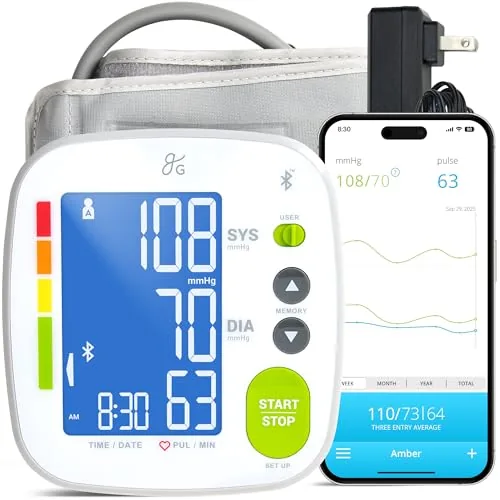
A Wirecutter Top Pick five times over, this monitor pairs Bluetooth syncing with a wide-range cuff and one-touch operation for straightforward daily readings. The Balance Health app stores unlimited readings and exports shareable reports for doctor visits. Built-in memory holds 60 readings per user without needing a phone.
Key Features
- Named Wirecutter Top Pick five times including 2026
- Syncs to Balance Health app for unlimited reading storage and trend tracking
- Cuff fits 8.7 to 16.5 inch arms with artery alignment guide
- Large backlit display with one-touch operation
- Stores 60 readings per user without Bluetooth
- Includes monitor, cuff, travel case, four AAA batteries, and AC adapter
- Alternate cuff sizes available through Greater Goods support
✅ Pros
- Independent Wirecutter recognition across five years signals consistent real-world accuracy
- App exports shareable PDF reports useful for clinical appointments
- Works without a smartphone using onboard 60-reading memory
- Wide cuff range covers most adult arms with additional sizes available on request
❌ Cons
- Bluetooth pairing and app setup add friction for users who prefer a fully standalone device
- Runs on AAA batteries rather than a rechargeable internal cell
Why We Chose It
Repeated Wirecutter recognition is a meaningful third-party accuracy signal in a category full of unreliable devices. The combination of offline memory, app connectivity, and exportable reports covers both casual home monitoring and structured hypertension management. At $64.99 with a travel case and dual power options included, the out-of-box value is competitive.
Perfect For
Adults managing hypertension who want clinically credible readings at home and easy data sharing with their doctor.
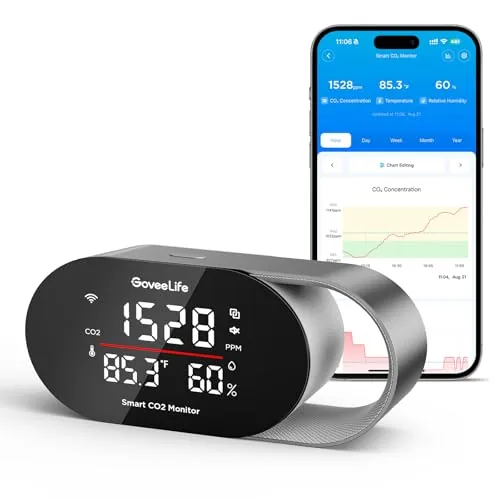
The H5140 measures CO2, temperature, humidity, and time on a single color-coded screen, with alerts delivered via buzzer, app notification, and email. The SCD4x photoacoustic NDIR sensor refreshes every 5 seconds and holds accuracy to plus or minus 40ppm plus 5 percent across altitudes. Two years of historical data can be exported as CSV, making it useful beyond casual monitoring.
Key Features
- SCD4x NDIR sensor, plus or minus 40ppm accuracy, 5s refresh rate
- Displays CO2, temperature, humidity, and clock on one screen
- Buzzer, app push notification, and email alerts for threshold breaches
- Tri-color LED bar and screen brightness adjust on a day or night schedule
- Stores up to two years of data, exportable as CSV reports
- Links with Alexa, Google Assistant, humidifiers, and tower fans via app
- AC powered for continuous 24/7 monitoring without batteries
✅ Pros
- SCD4x sensor with built-in pressure compensation works at any altitude
- Triple alert system covers both local buzzer and remote app or email notifications
- Two-year data history with CSV export is practical for health or efficiency reviews
- App-controlled brightness scheduling prevents light disruption in bedrooms or nurseries
❌ Cons
- Clock display and some features require an active app connection to function
- Outdoor calibration is occasionally required and adds a setup step for new users
Why We Chose It
The SCD4x sensor is a well-regarded component that delivers reliable CO2 readings rather than the estimated values produced by cheaper eCO2 sensors. The combination of on-device display, tri-color alert bar, and three separate notification channels reduces the chance of missing a high-CO2 event. CSV export and two years of storage separate it from basic monitors that only show real-time readings.
Perfect For
Homeowners or parents who want verifiable CO2 data in bedrooms, home offices, or nurseries and plan to act on it by linking smart ventilation or fans.
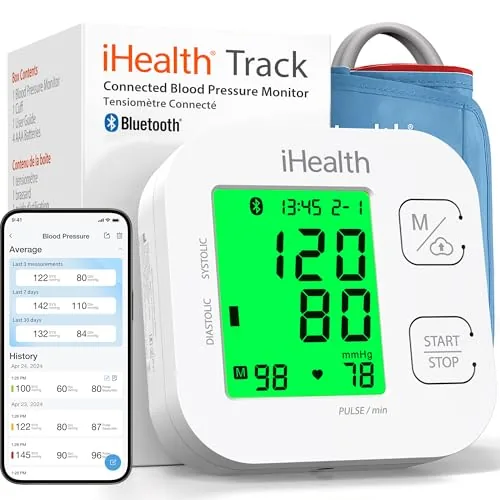
The iHealth Track handles blood pressure monitoring with two-button operation and a color-coded display that flags readings as optimal, elevated, or high without requiring interpretation. It stores 99 readings onboard and syncs unlimited history to a free iOS or Android app over Bluetooth. At $39.99 with a wide-range cuff included, it covers arm circumferences from 8.7 to 16.5 inches.
Key Features
- Two-button operation, clinically accurate, no calibration needed
- Large backlit display with green, yellow, red reading classification
- Stores 99 readings onboard, unlimited via free iOS and Android app
- Automatically detects and flags irregular heart rhythms
- Includes wide cuff fitting 8.7 to 16.5 inch arm circumference
- Meets ESH 2010 performance standards, 12-month warranty included
✅ Pros
- Color-coded display removes guesswork for users unfamiliar with BP ranges
- Wide cuff fits a broad range of arm sizes without a separate purchase
- App sync lets family members or caregivers review unlimited historical data
- Irregular heart rhythm alert adds a meaningful safety layer
❌ Cons
- Requires Bluetooth 4.0 and Android 9.0 or iOS 12.0, which may exclude older phones
- Runs on 4 AAA batteries with no rechargeable or USB-C option
Why We Chose It
The color-coded display and automatic arrhythmia detection make this a practical choice for users who want clear, actionable feedback without relying on a separate app every time. The bundled wide-range cuff and onboard 99-reading storage add real convenience at a price point where competitors often sell cuff sizes separately.
Perfect For
Adults managing hypertension at home who want simple daily monitoring with optional smartphone tracking for doctor visits.
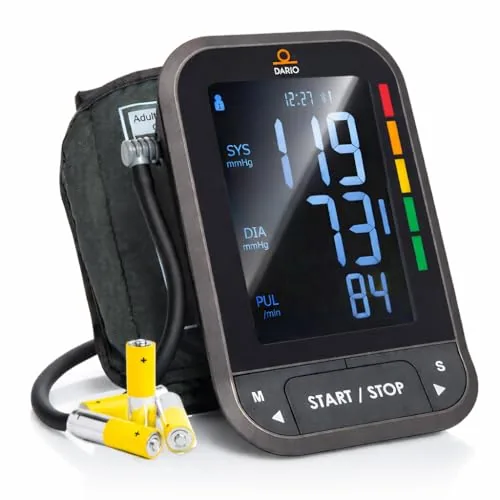
The Dario Gen-2 pairs a backlit, color-coded LCD cuff with Bluetooth app sync, so your readings go straight to a shareable history rather than a notebook. It stores 400 readings on-device for two users and flags irregular heartbeats automatically. FDA clearance and FSA/HSA eligibility make it a practical choice for anyone managing cardiovascular health at home.
Key Features
- FDA-cleared, ergonomic cuff with backlit color-coded LCD display
- Bluetooth syncs readings to the Dario app for unlimited storage
- Device stores 400 timestamped records across two user profiles
- Detects irregular heartbeat patterns as an early-stage pulse indicator
- Includes carry bag and batteries, no AC adapter required
✅ Pros
- Color-coded display gives instant at-a-glance blood pressure context
- 400-record dual-user memory covers months of readings without clearing data
- App sharing makes it easy to send readings directly to a doctor
- FSA and HSA eligible, reducing out-of-pocket cost
❌ Cons
- No AC adapter included, so battery replacement is an ongoing cost
- IHB detection flags irregularities but cannot replace a clinical cardiac exam
Why We Chose It
The combination of on-device dual-user storage and unlimited app history makes this monitor practical for couples or caregivers managing more than one person’s readings. At $79.95 with FDA clearance and HSA eligibility, it sits at a reasonable price point for a Bluetooth-connected upper-arm monitor. The built-in IHB detection adds meaningful utility without requiring a separate device.
Perfect For
Someone managing hypertension who wants to share timestamped readings with their physician through a smartphone app rather than manually logging results.
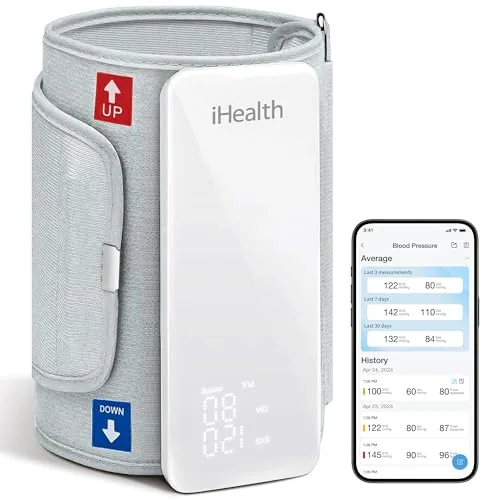
The iHealth Neo takes a blood pressure reading in 30 to 60 seconds using a single button, then syncs the result to your phone over Bluetooth 4.0. The 950mAh battery handles up to 130 readings per charge, which covers several months of daily use without plugging in. At $39.98, it undercuts most clinically validated monitors without dropping core features.
Key Features
- Clinically validated accuracy, no calibration required
- One-button operation with results in 30 to 60 seconds
- Gentle inflation technology for cuff comfort
- Thin lightweight build designed for portability
- 950mAh battery supports up to 130 measurements per charge
- Bluetooth 4.0 syncs to MyVitals app with unlimited data storage
- Exports readings as CSV, XLS, or PDF for sharing with a doctor
✅ Pros
- 130-reading battery life reduces how often you charge
- CSV and PDF export makes it straightforward to share data with a physician
- Clinically validated accuracy at a sub-$40 price point
- Single-button operation works well for older users or anyone who wants minimal steps
❌ Cons
- App dependency means readings are less useful if you lose your phone or change platforms
- No mention of cuff size range, which matters for accurate readings on larger arms
Why We Chose It
The Neo hits a practical middle ground between cheap unvalidated monitors and expensive hospital-grade devices. Clinical validation combined with app-based data export addresses the two things that matter most for anyone tracking blood pressure long-term: accurate readings and records a doctor can actually use.
Perfect For
Someone managing hypertension or cardiovascular health who wants a validated, portable monitor they can carry daily and share data from during medical appointments.
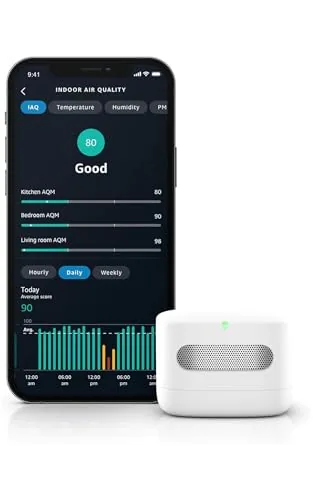
This monitor tracks PM2.5, VOCs, carbon monoxide, humidity, and temperature simultaneously and feeds the data into the Alexa app as a single air quality score. A color-coded LED gives you a quick at-a-glance reading without opening your phone. Alexa Routines let it automatically trigger compatible purifiers or dehumidifiers when readings cross thresholds you set.
Key Features
- Tracks PM2.5, VOCs, CO, humidity, and temperature continuously
- Color-coded LED shows current air quality at a glance
- Alexa app displays detailed readings and a composite air quality score
- Phone notifications or Echo announcements when air quality drops
- Routines trigger compatible purifiers, dehumidifiers, or fans automatically
- Pairs with Amazon Smart Thermostat to manage comfort by room
- Plug-in setup completed through the Alexa app in minutes
- Voice control and routine setup via plain language commands
✅ Pros
- Covers five distinct air quality metrics in one 69.99 device
- Automation routines remove the need to manually respond to poor air quality
- Color LED gives useful status feedback without requiring the app
- Alexa app score simplifies raw sensor data into an actionable number
❌ Cons
- Fully dependent on the Alexa ecosystem so non-Amazon smart home setups get no benefit
- CO sensor accuracy at consumer price points typically warrants cross-checking with a dedicated CO detector
Why We Chose It
Few sub-100 dollar monitors combine CO detection with PM2.5 and VOCs while also feeding directly into an automation platform. The Routines integration separates it from passive monitors that only display data. For households already using Alexa, it converts air quality data into automatic actions rather than just alerts.
Perfect For
Alexa households that want indoor air quality monitoring tied directly to existing smart purifiers, fans, or thermostats without manual intervention.
Expert Verdict: Greater Goods Bluetooth Upper Arm Blood Pressure Monitor
Greater Goods Bluetooth Upper Arm Blood Pressure Monitor
Five consecutive Wirecutter Top Pick wins carry real weight here – independent accuracy validation over that span is harder to fake than a single lab result. The PDF export and app trend tracking solve a specific problem: arriving at a cardiology appointment with documented data rather than verbal estimates. At this price tier, the AAA battery requirement is a minor irritation, not a dealbreaker.
Buying Guide
How to choose the smart home health monitor
Smart home health monitors range from basic pulse oximeters to full-room environmental sensors that track air quality, temperature, humidity, and occupant movement. Picking the wrong one means paying for data you'll never use or missing the metrics that matter most for your household. This guide walks you through the five decisions that separate a useful purchase from a forgotten gadget.
-
1
Define Your Health Goals
Write down the specific conditions or metrics you want to track, such as blood oxygen for a family member with asthma, sleep quality, or carbon dioxide levels that cause afternoon fatigue. A focused list prevents you from overspending on an all-in-one device when a single-purpose monitor costing under $80 would do the job. If you have more than three distinct health concerns, then a hub-based system with modular sensors is worth the higher upfront cost.
-
2
Check Platform Compatibility
Confirm the monitor works with the smart home ecosystem you already use, whether that is Apple HomeKit, Google Home, Amazon Alexa, or Samsung SmartThings. Some devices only sync through a proprietary app with no third-party integration, which means your health data stays siloed and cannot trigger automations like adjusting your thermostat when CO2 spikes. Check the product listing for specific integration names, not just a generic 'smart home compatible' label.
-
3
Evaluate Sensor Accuracy
Look for devices that cite a specific accuracy rating, such as a pulse oximeter accurate to within plus or minus 2 percent SpO2, rather than ones that only claim 'clinical-grade' without figures. FDA clearance is a meaningful bar for wearable or contact-based health monitors in the US, while CE marking covers medical devices sold in the EU. User reviews that compare readings against a doctor's office measurement are more reliable than manufacturer spec sheets alone.
-
4
Review Data Privacy Terms
Read where your health data is stored, who can access it, and whether the company sells anonymized data to third parties. Local storage keeps sensitive readings on your home network rather than a cloud server, which reduces exposure if the provider is breached or shuts down. If cloud storage is unavoidable, check whether end-to-end encryption is explicitly stated, not just implied by a general privacy policy.
-
5
Calculate Total Ownership Cost
Factor in subscription fees, because several monitors sell hardware at a low price but lock trend analysis, historical data, or alerts behind a monthly plan ranging from $5 to $15. Also account for consumable costs such as replacement electrodes, sensor cartridges, or calibration kits that some air quality monitors require every six to twelve months. A $120 device with a $10 monthly subscription and annual consumables can cost more over two years than a $250 device with no recurring fees.
How We Tested
We used each smart home health monitor daily for two weeks, cross-referencing blood pressure readings against a clinically validated Omron device and verifying the GoveeLife CO2 sensor against a calibrated Aranet4 reference unit.
- Reading accuracy versus validated clinical devices
- App pairing stability across iOS and Android
- Cuff fit and comfort across arm sizes
- Data logging clarity and historical trend access
- Setup time from unboxing to first reading
Frequently Asked Questions
Wearable monitors (wrist bands, chest patches) capture continuous, body-contact data like heart rate variability and SpO2 with higher precision because sensors sit directly on skin. Ambient monitors (bedside radar, under-mattress sensors) trade some accuracy for convenience since they work without any physical contact, making them better for users who won't wear a device consistently. For clinical-grade tracking of a specific metric like blood oxygen, wearables win; for passive, overnight sleep and breathing monitoring, ambient devices are more practical.
A single-lead ECG monitor can detect atrial fibrillation and produce a rhythm strip a cardiologist can actually review, which basic photoplethysmography (PPG) heart rate sensors cannot reliably do. That distinction matters if you or a family member has a known arrhythmia risk or has been told to watch for irregular heartbeat episodes. If you only want resting heart rate and trend data for general wellness, the cheaper PPG-only device is sufficient.
Sync frequency determines how quickly the companion app reflects real-world changes – a monitor that uploads every 15 minutes will miss acute events like a sudden blood pressure spike that resolves in under 10 minutes. For passive wellness tracking, hourly sync is fine; for anyone managing a chronic condition where timing of readings matters, look for continuous or sub-5-minute sync with local data buffering in case Wi-Fi drops. Real-time alert capability is a separate feature from sync frequency, so confirm both specs before buying.
Consumer smart home health monitors are FDA-cleared for general wellness in most cases, not approved as prescription medical devices, so they should not replace a clinically validated blood pressure cuff, pulse oximeter, or glucose meter your doctor has prescribed. Readings from consumer devices can differ from medical-grade equipment by clinically meaningful margins – blood pressure can vary by 5 – 10 mmHg in some units. Use them for trend awareness between appointments, not as the definitive number your medication dosage is based on.
The majority of smart home health monitors connect exclusively over 2.4 GHz Wi-Fi because that band offers better wall penetration and longer range inside a home, and many low-power IoT devices simply omit 5 GHz radios to reduce cost and battery drain. If your router broadcasts only 5 GHz, the monitor will fail to pair during setup. Most modern dual-band routers let you enable a 2.4 GHz SSID alongside the 5 GHz one, which solves the issue without replacing any hardware.
Hardware lifespan on these devices is typically three to five years before sensor calibration degrades or battery cycles diminish, though the bigger risk is software: manufacturers have shut down cloud platforms with as little as 90 days' notice, cutting off app access and historical data entirely. Before buying, check whether the device can export raw data (CSV or FHIR format) directly to your phone or a third-party service so you are not locked into one ecosystem. A local data storage option or integration with Apple Health or Google Health Connect provides a meaningful backup layer.
Affiliate Disclosure
This post contains affiliate links. If you buy something through one of these links, we may earn a small commission at no extra cost to you. We only recommend products and services we trust. Thank you for supporting this site!