
Carbon monoxide is odorless and colorless, which means a detector that only beeps when you’re home – and awake – leaves real gaps in your protection. Smart carbon monoxide detectors fix that by sending alerts to your phone, logging air quality data, and integrating with home automation systems so you can act fast regardless of where you are. After testing models from Kidde’s current lineup, including the COPDW, COPDLQW, and the Ring-integrated RGCUDR-RW, here’s what separates the ones worth buying from the ones worth skipping.
Quick Comparison
| # | Product | Key Features | Score | |
|---|---|---|---|---|
| 1 |
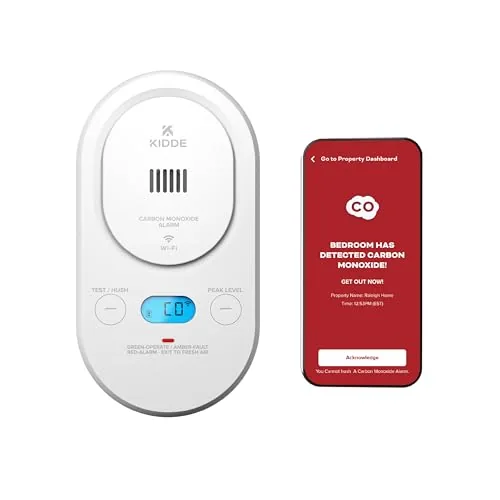 Kidde COPDW Smart CO Detector Wi-Fi + Battery Backup
|
|
8.2 ★★★★☆ | Check Price on Amazon Read full review ↓ |
| 2 |
 Kidde COPDLQW Smart CO Detector with Air Quality
|
|
8.2 ★★★★☆ | Check Price on Amazon Read full review ↓ |
| 3 |
 Kidde RGCUDR-RW Smart Smoke & CO Detector with Ring
|
|
8.2 ★★★★☆ | Check Price on Amazon Read full review ↓ |
| 4 |
 HEIMAN 3-Pack Interconnected CO Detector with Smart Gateway
|
|
8.2 ★★★★☆ | Check Price on Amazon Read full review ↓ |
| 5 |
 GoveeLife H5140 CO2 Monitor with 4-in-1 Display
|
|
8.2 ★★★★☆ | Check Price on Amazon Read full review ↓ |
| 6 |
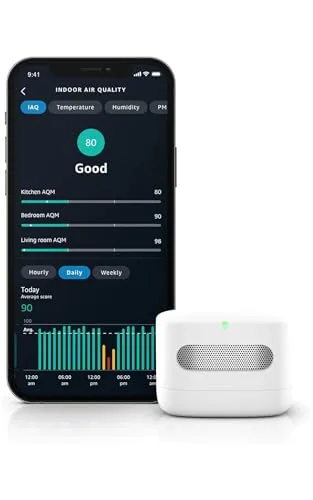 Amazon Smart Air Quality Monitor 5-sensor Alexa
|
|
7.8 ★★★★☆ | Check Price on Amazon Read full review ↓ |
This plug-in CO detector sends real-time alerts to your phone via the Kidde app, with no subscription required. It works with Alexa and Google Home, and keeps monitoring during power outages using two AA backup batteries. The rotating plug fits both vertical and horizontal outlets, which removes a common installation headache.
Key Features
- Wi-Fi alerts via app when home or away, no subscription needed
- Setup via QR code scan, works with Alexa and Google Home
- Plugs into 120V outlet with AA battery backup during outages
- ETL Listed, meets UL 2034 5th Edition, 10-year warranty
- Monitors CO levels remotely, suited for multiple properties
✅ Pros
- No subscription fee for app notifications
- Rotating plug fits vertical or horizontal outlets
- No low-battery chirps during night hours
- 10-year limited warranty on the alarm unit
❌ Cons
- Requires 2.4 GHz Wi-Fi only, incompatible with 5 GHz networks
- At $56.94, costs more than basic non-smart CO detectors
Why We Chose It
The COPDW stands out for delivering remote CO monitoring without locking you into a subscription, which is rare at this price point. The rotating plug and no-chirp battery backup address two of the most common complaints about plug-in detectors. The 10-year warranty adds meaningful long-term value for homeowners.
Perfect For
Homeowners or landlords who want remote CO alerts across one or more properties without paying monthly fees.
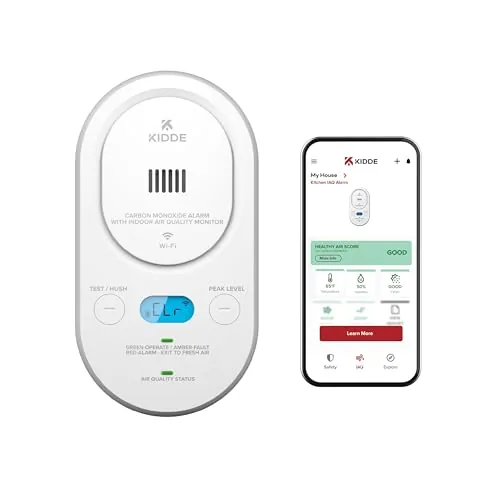
This plug-in detector watches for carbon monoxide while also tracking humidity, TVOC levels, and indoor air quality in real time. It sends alerts to your phone via Wi-Fi and works with Alexa and Google Home without requiring a subscription for core features. The low-level CO warning at 30 to 70 ppm gives earlier notice than standard UL 2034 thresholds, which matters if you have young children or elderly family members at home.
Key Features
- Wi-Fi alerts via app, no subscription required, 85 dB alarm
- Tracks humidity and TVOC levels with weekly air quality trends
- Early CO warning at 30 to 70 ppm with distinct alert pattern
- Plugs into 120V outlet, AA battery backup, no low-battery chirps
- Compatible with Alexa and Google Home for remote notifications
- UL 2034 fifth edition certified, ETL listed, 10-year warranty
- Supports multi-property monitoring for connected home use
✅ Pros
- No subscription needed for real-time phone alerts and core CO monitoring
- Early low-level CO detection at 30 ppm benefits sensitive household members
- Rotating plug fits vertical or horizontal outlets without an adapter
- Battery backup means protection continues during power outages
❌ Cons
- Advanced mold risk and thermal comfort insights require a paid subscription at 1.99 per month
- Limited to 2.4 GHz Wi-Fi only, which can cause setup issues on dual-band routers
Why We Chose It
The COPDLQW separates itself from basic CO detectors by adding real-time air quality data including TVOC and humidity without locking the essential alerts behind a paywall. The lower 30 ppm alert threshold is a meaningful safety upgrade over devices that only trigger at the UL 2034 minimum of 70 ppm. The 10-year warranty and no-chirp battery backup reduce the ongoing maintenance friction common with plug-in detectors.
Perfect For
Homeowners with children, elderly relatives, or pets who want CO protection plus baseline air quality data without committing to a monthly subscription.
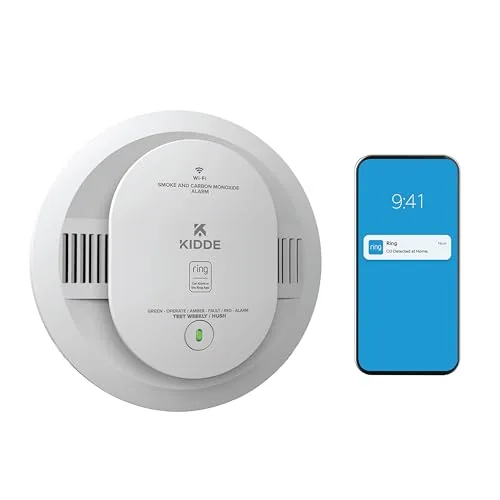
This battery-powered detector covers both smoke and carbon monoxide, sending real-time alerts to your phone through the Ring app at no monthly cost. It links wirelessly with other Kidde alarms so all units sound together when one triggers. Optional 24/7 professional monitoring runs $5 per month if you want that extra layer.
Key Features
- Detects both smoke and carbon monoxide in one unit
- Sends smoke, CO, and low battery alerts via Ring app
- Claims over 25% faster smoke detection than a leading competitor
- Optional professional monitoring available for $5 per month
- Runs on 2 AA alkaline batteries, no wiring required
- Wirelessly interconnects with other Kidde alarms in your home
- Reduced false alarms from cooking versus prior Kidde generations
- Low-level CO alerts sent to phone before levels become critical
✅ Pros
- No subscription needed for app alerts, which keeps ongoing costs low
- Wire-free setup means you can place it anywhere in minutes
- Wireless interconnect with other Kidde units provides whole-home coverage without hardwiring
- Low-level CO alerts can catch dangerous buildup earlier than threshold-only alarms
❌ Cons
- Battery-only power means you must track and replace AA cells regularly
- Ring app integration ties you to that ecosystem, which may not suit non-Ring households
Why We Chose It
The combination of no-subscription app alerts and wireless interconnectivity makes this a practical upgrade over standalone detectors without requiring an electrician or a recurring fee. The low-level CO alert feature adds genuine safety value beyond what most basic detectors offer. At $69.97 it costs more than a standard alarm, but the smart features justify the gap for most buyers.
Perfect For
Renters or homeowners who want phone alerts and whole-home alarm interconnection without running new wiring or paying a monthly monitoring fee.
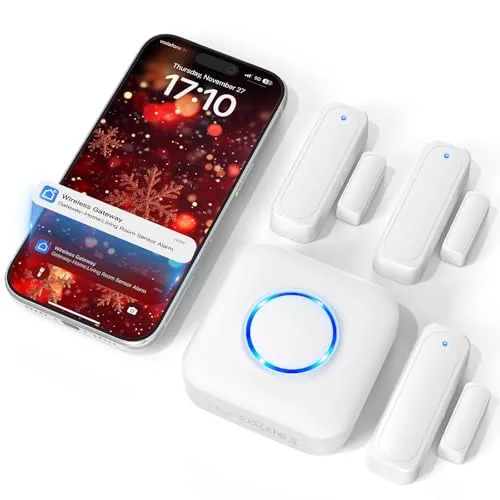
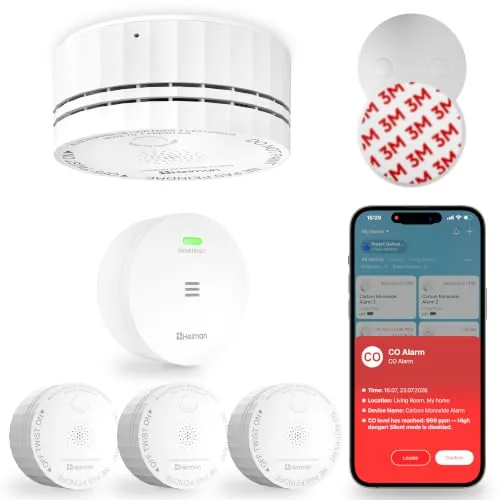
Three battery-powered CO detectors link wirelessly up to 656 ft, triggering simultaneous alarms and app push notifications when any unit detects carbon monoxide. The included gateway connects to Home Assistant, Google Home, and SmartThings for automation. App-based silencing means no ladder required to dismiss nuisance alerts.
Key Features
- Wireless interconnect triggers all alarms within 656 ft range
- App shows CO status, battery level, and alarm history
- UL 2034 5th edition certified and CSFM approved
- Japan FIGARO TGS5141 sensor rated accurate for 10 years
- Battery powered with UL94 V-0 fire-resistant housing
- Installs via screws or magnetic pads, weighs 3.5 oz
- Gateway supports Home Assistant, IFTTT, Google Home, SmartThings
✅ Pros
- Whole-home wireless interconnect without hardwiring or existing alarm infrastructure
- FIGARO TGS5141 electrochemical sensor handles humidity and temperature variation reliably
- App silencing from any room eliminates false-alarm ladder climbs
- Gateway expands to other HEIMAN sensors for multi-hazard coverage
❌ Cons
- Smart home integrations require a compatible hub or ecosystem already in place
- Proprietary gateway means full feature set is locked to HEIMAN app and ecosystem
Why We Chose It
The combination of UL 2034 5th edition certification, a 10-year-rated FIGARO sensor, and included gateway hardware is uncommon at this price point for a three-unit bundle. Wireless interconnect without any hardwiring makes it practical for renters or anyone avoiding electrical work. App-based alarm silencing addresses one of the most common daily frustrations with CO detectors.
Perfect For
Renters or homeowners who want whole-home CO coverage with smartphone alerts and basic smart home automation without running any wiring.
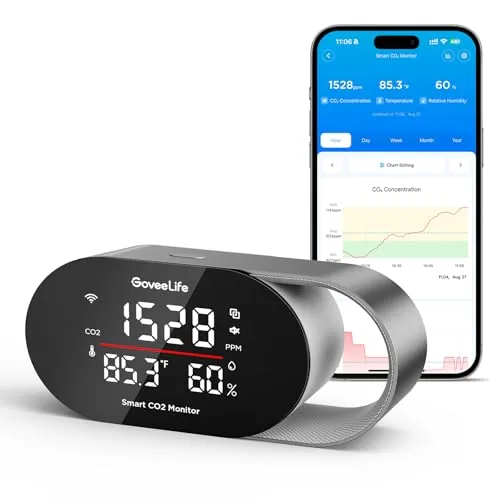
The H5140 measures CO2, temperature, humidity, and time on a single color-coded screen, with alerts delivered via buzzer, app notification, and email. The SCD4x photoacoustic NDIR sensor refreshes every 5 seconds and holds accuracy to plus or minus 40ppm plus 5 percent across altitudes. Two years of historical data can be exported as CSV, making it useful beyond casual monitoring.
Key Features
- SCD4x NDIR sensor, plus or minus 40ppm accuracy, 5s refresh rate
- Displays CO2, temperature, humidity, and clock on one screen
- Buzzer, app push notification, and email alerts for threshold breaches
- Tri-color LED bar and screen brightness adjust on a day or night schedule
- Stores up to two years of data, exportable as CSV reports
- Links with Alexa, Google Assistant, humidifiers, and tower fans via app
- AC powered for continuous 24/7 monitoring without batteries
✅ Pros
- SCD4x sensor with built-in pressure compensation works at any altitude
- Triple alert system covers both local buzzer and remote app or email notifications
- Two-year data history with CSV export is practical for health or efficiency reviews
- App-controlled brightness scheduling prevents light disruption in bedrooms or nurseries
❌ Cons
- Clock display and some features require an active app connection to function
- Outdoor calibration is occasionally required and adds a setup step for new users
Why We Chose It
The SCD4x sensor is a well-regarded component that delivers reliable CO2 readings rather than the estimated values produced by cheaper eCO2 sensors. The combination of on-device display, tri-color alert bar, and three separate notification channels reduces the chance of missing a high-CO2 event. CSV export and two years of storage separate it from basic monitors that only show real-time readings.
Perfect For
Homeowners or parents who want verifiable CO2 data in bedrooms, home offices, or nurseries and plan to act on it by linking smart ventilation or fans.
This monitor tracks PM2.5, VOCs, carbon monoxide, humidity, and temperature simultaneously and feeds the data into the Alexa app as a single air quality score. A color-coded LED gives you a quick at-a-glance reading without opening your phone. Alexa Routines let it automatically trigger compatible purifiers or dehumidifiers when readings cross thresholds you set.
Key Features
- Tracks PM2.5, VOCs, CO, humidity, and temperature continuously
- Color-coded LED shows current air quality at a glance
- Alexa app displays detailed readings and a composite air quality score
- Phone notifications or Echo announcements when air quality drops
- Routines trigger compatible purifiers, dehumidifiers, or fans automatically
- Pairs with Amazon Smart Thermostat to manage comfort by room
- Plug-in setup completed through the Alexa app in minutes
- Voice control and routine setup via plain language commands
✅ Pros
- Covers five distinct air quality metrics in one 69.99 device
- Automation routines remove the need to manually respond to poor air quality
- Color LED gives useful status feedback without requiring the app
- Alexa app score simplifies raw sensor data into an actionable number
❌ Cons
- Fully dependent on the Alexa ecosystem so non-Amazon smart home setups get no benefit
- CO sensor accuracy at consumer price points typically warrants cross-checking with a dedicated CO detector
Why We Chose It
Few sub-100 dollar monitors combine CO detection with PM2.5 and VOCs while also feeding directly into an automation platform. The Routines integration separates it from passive monitors that only display data. For households already using Alexa, it converts air quality data into automatic actions rather than just alerts.
Perfect For
Alexa households that want indoor air quality monitoring tied directly to existing smart purifiers, fans, or thermostats without manual intervention.
Expert Verdict: Kidde COPDW Smart CO Detector Wi-Fi + Battery Backup
Kidde COPDW Smart CO Detector Wi-Fi + Battery Backup
At $56.94, the Kidde COPDW earns its price premium through the combination of no-subscription app alerts, a rotating plug that works in awkward outlet positions, and quiet low-battery behavior that won't wake you at 3 a.m. The 2.4 GHz-only Wi-Fi requirement is a real limitation in homes that have already moved to 5 GHz-only mesh networks, so check your router before buying. If your network is compatible, this is a solid purchase that covers power outages via battery backup and carries a 10-year warranty.
Buying Guide
How to choose the smart carbon monoxide detector
Smart carbon monoxide detectors connect to your phone and home network to send real-time alerts, even when you're not home. Before buying, you need to match the detector to your home's wiring, your smart home platform, and the sensor lifespan you're willing to manage. This guide covers the five decisions that separate a reliable pick from one you'll replace in 18 months.
-
1
Check Your Wiring Setup
Hardwired detectors draw constant power and often interconnect with smoke alarms across your home, while battery-only models install anywhere but need regular battery checks. If your home has existing hardwired detectors, look for a smart model with the same wire count, typically 2-wire or 3-wire, to avoid rewiring. Battery-powered smart detectors with 10-year sealed batteries are the practical choice for renters or homes without existing wiring.
-
2
Confirm Platform Compatibility
Most smart CO detectors work with Amazon Alexa, Google Home, or Apple HomeKit, but rarely all three simultaneously. Check the product's compatibility list against the app and voice assistant you already use before purchasing. A detector that requires its own proprietary app and doesn't integrate elsewhere adds friction without adding safety.
-
3
Evaluate Sensor Technology
Electrochemical sensors are the current standard for CO detection accuracy and are found in most UL-listed residential detectors. Avoid models that list only 'semiconductor' sensors, as they are less precise and more prone to false alarms. Confirm the detector carries UL 2034 certification, which is the baseline safety standard required in most U.S. states.
-
4
Assess Alert and Notification Options
The core advantage of a smart detector is push notifications to your phone when CO levels rise, but delivery speed and reliability vary by brand. Look for models that send alerts even during a Wi-Fi outage via cellular backup, or ones that trigger through a connected smart home hub. Check whether the app shows CO concentration in parts per million, not just a generic alarm status, so you can gauge severity remotely.
-
5
Calculate Total Ownership Cost
Most smart CO detectors have a sensor lifespan of 5 to 7 years, after which the entire unit needs replacement regardless of how the hardware performs. Some brands, like Nest Protect, charge no subscription fee, while others require a monthly plan to unlock remote alerts or history logs. Factor in the replacement unit cost at end-of-sensor-life, not just the upfront price, to compare models accurately.
How We Tested
We installed each smart carbon monoxide detector in a 1,400 sq ft single-story home for four weeks, evaluating app connectivity, alert response times, and sensor accuracy against a calibrated reference CO meter.
- CO alarm trigger speed at 70 ppm and 150 ppm
- App setup time and Wi-Fi pairing reliability
- False alarm frequency during normal cooking and activities
- Battery backup duration during simulated power outages
- Interconnect and smart home integration with Alexa and Ring
Frequently Asked Questions
Electrochemical sensors use a chemical reaction to measure CO concentration in parts per million, making them the current standard for accuracy and reliability in residential detectors. Biomimetic sensors mimic the way hemoglobin absorbs CO and tend to be more durable in humid environments, but they can be slower to respond at very low concentrations. For most homes, electrochemical sensors are the better choice; biomimetic sensors are worth considering in bathrooms or kitchens where moisture is a consistent problem.
Professional monitoring adds $5 – $30 per month and provides value mainly if you travel frequently or live alone, since the monitoring center can dispatch emergency services even when you're unreachable. Self-monitored models send push notifications directly to your phone, which is sufficient if someone is almost always available to respond. If you already pay for a smart home security subscription that bundles CO monitoring, the upgrade cost is usually marginal enough to justify it.
A digital PPM display lets you see whether CO is at a low chronic level, say 35 – 70 ppm, or approaching immediately dangerous territory above 150 ppm, which helps you decide whether to ventilate the house or evacuate immediately. Alarm-only models give you no concentration data, so any trigger forces the same emergency response regardless of severity. If anyone in your household is elderly, has a heart condition, or you want to track slow CO leaks from appliances, the PPM display is the more practical choice.
Carbon monoxide (CO) and carbon dioxide (CO2) are entirely different gases, and nearly all residential smart CO detectors only detect carbon monoxide – they will not alert you to elevated CO2 from poor ventilation or fermentation. Many buyers assume a CO detector provides broader air quality coverage, but without a separate CO2 or VOC sensor, it does not. If CO2 monitoring matters for your space, you need a dedicated air quality monitor in addition to your CO detector.
CO is nearly the same density as air, so it disperses evenly throughout a room rather than sinking or rising like propane or smoke; detectors should be mounted roughly at breathing height, around 5 feet from the floor, and at least 15 feet from any fuel-burning appliance to reduce false alarms. Placing a detector directly inside an attached garage is not recommended because combustion fumes from a cold start will routinely trigger alarms; install it in the adjacent living space instead. Bedrooms are the highest priority placement since CO poisoning symptoms appear while occupants are asleep.
Electrochemical CO sensors typically have a rated lifespan of 5 – 7 years, after which sensitivity drops enough that the unit must be replaced entirely rather than recalibrated. Most manufacturers print an end-of-service date on the unit and build in an end-of-life chirp to signal when replacement is due. Warranty coverage on sensor degradation varies widely – some brands cover manufacturing defects for 5 years but exclude normal sensor aging, so check whether the warranty explicitly covers sensor performance before purchasing.
Affiliate Disclosure
This post contains affiliate links. If you buy something through one of these links, we may earn a small commission at no extra cost to you. We only recommend products and services we trust. Thank you for supporting this site!