
Smart relay switches let you automate existing lights, fans, and appliances without replacing the fixtures themselves – you wire the relay behind the switch or inside a junction box, and it handles the on/off logic remotely or on a schedule. The catch is that the wrong relay in a tight electrical box, or one locked into a single protocol, creates more headaches than it solves. After testing the Shelly 1 Gen4 Wi-Fi Zigbee Matter, the UL-listed version of the same, and the compact Shelly 1 Mini Gen4, here’s what each one actually delivers and where each one falls short.
Quick Comparison
| # | Product | Key Features | Score | |
|---|---|---|---|---|
| 1 |
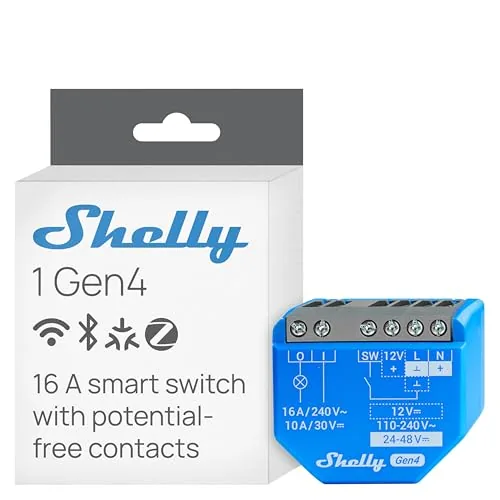 Shelly 1 Gen4 Wi-Fi Zigbee Matter Relay Switch
|
|
8.5 ★★★★☆ | Check Price on Amazon Read full review ↓ |
| 2 |
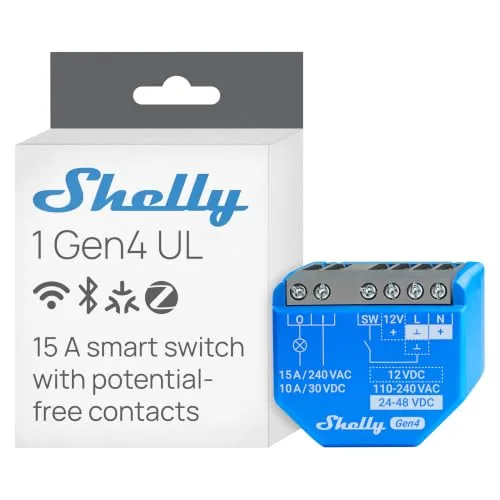 Shelly 1 Gen4 UL Smart Relay Wi-Fi Zigbee Matter
|
|
8.5 ★★★★☆ | Check Price on Amazon Read full review ↓ |
| 3 |
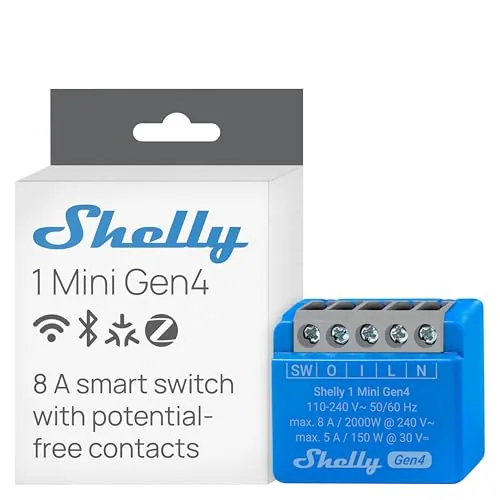 Shelly 1 Mini Gen4 Wi-Fi Matter Zigbee Relay
|
|
8.5 ★★★★☆ | Check Price on Amazon Read full review ↓ |
| 4 |
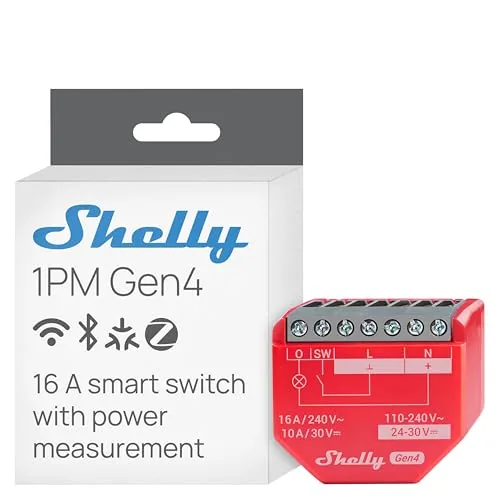 Shelly 1PM Gen4 Smart Relay with Power Metering
|
|
8.5 ★★★★☆ | Check Price on Amazon Read full review ↓ |
| 5 |
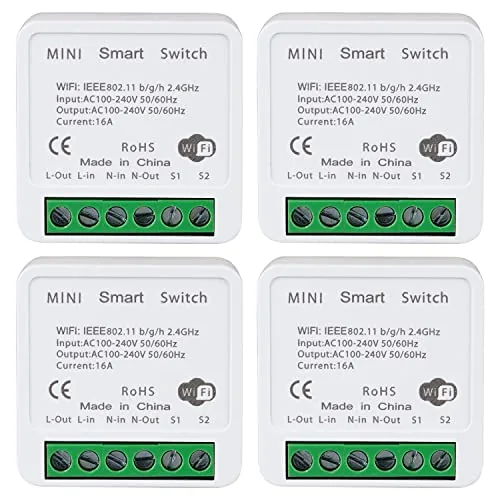 Bkiyougo WiFi Smart Switch 16A No-Hub 4-Pack
|
|
8.2 ★★★★☆ | Check Price on Amazon Read full review ↓ |
| 6 |
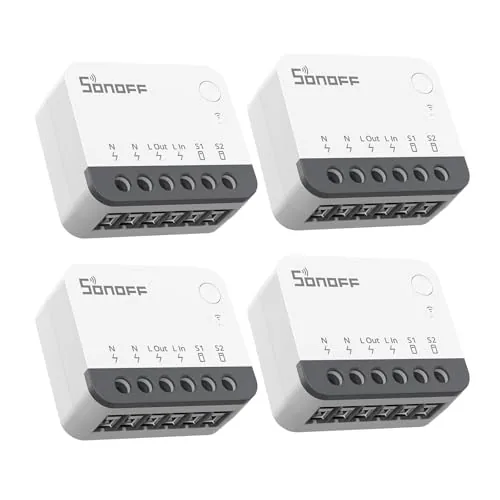 SONOFF ZBMINIR2 Zigbee 3.0 In-Wall Relay 4-Pack
|
|
8.2 ★★★★☆ | Check Price on Amazon Read full review ↓ |
The Shelly 1 Gen4 fits behind existing wall switches and outlets to add remote control and automation without replacing fixtures. It supports Wi-Fi, Zigbee, and Matter simultaneously, so it works with most major smart home platforms out of the box. At $24.99 with a 3-year warranty, it covers a wide range of use cases from lighting schedules to garage door control.
Key Features
- Single 16A dry-contact relay with Wi-Fi, Zigbee, and Matter support
- Compatible with Alexa, Google Home, Home Assistant, and SmartThings
- Automate lighting by schedule, sunset trigger, or remote command
- Controls garage doors on 12V and 24-48V DC systems
- Acts as a Bluetooth gateway for nearby devices
- Compact form factor fits standard wall boxes and tight spaces
- 3-year warranty included with professional support
✅ Pros
- Supports Wi-Fi, Zigbee, and Matter so it integrates with most ecosystems without a hub
- Dry contacts allow control of low-voltage systems like garage doors alongside standard lighting
- Compact enough to retrofit into existing switches and outlets without new wiring
- 3-year warranty is longer than most competitors in this price range
❌ Cons
- Garage door status monitoring requires purchasing a Reed switch and Shelly Plus Add-on separately
- No built-in energy monitoring unlike some competing relay switches at similar prices
Why We Chose It
Few relay switches at this price point offer all three of Wi-Fi, Zigbee, and Matter in a single unit. The dry-contact output and DC voltage compatibility give it genuine flexibility beyond basic light switching. The 3-year warranty adds meaningful long-term value for a device installed inside a wall.
Perfect For
Homeowners retrofitting existing switches and outlets with smart control who want broad platform compatibility without committing to a single ecosystem.
The Shelly 1 Gen4 is a compact 15A relay that fits inside standard wall boxes and works without a hub across Wi-Fi, Zigbee, and Matter networks. At $27.99 it covers garage door control, lighting automation, and dry-contact switching in a single device. UL certification and a 3-year warranty add reliability you rarely get at this price point.
Key Features
- UL-certified, single 15A dry-contact relay, Wi-Fi, Zigbee, Matter
- Works with Alexa, Google Home, Home Assistant, SmartThings, Shelly app
- Automates lights by schedule, sunset trigger, or remote command
- Controls 12V and 24-48V DC garage doors, compatible with Reed switch
- 3-year warranty, Bluetooth gateway built in, no hub required
✅ Pros
- Fits standard wall boxes, power sockets, and light switch enclosures
- Triple-protocol support (Wi-Fi, Zigbee, Matter) future-proofs integrations
- UL certified for North American installations, unusual at this price
- Also acts as a Bluetooth gateway, adding value beyond basic switching
❌ Cons
- Garage door status monitoring requires a separate Reed switch and Shelly Plus Add-on
- App-based setup may add friction for users new to Shelly’s ecosystem
Why We Chose It
Few relays under $30 carry UL certification, support Matter natively, and double as a Bluetooth gateway. The 15A rating handles most household loads, and the compact form factor makes retrofitting genuinely straightforward rather than a project.
Perfect For
Homeowners who want a no-hub smart relay that plays well with multiple platforms and passes North American electrical standards.
The Shelly 1 Mini Gen4 packs Wi-Fi, Zigbee, and Matter support into a relay small enough to fit inside a switch box or appliance casing. It handles up to 8A, covers lights, coffee makers, and garage door openers without a hub. The upgraded processor and 8MB of memory keep response times fast and local automations reliable.
Key Features
- Wi-Fi, Zigbee, and Matter support with no hub required
- 8A dry-contact relay suits lights, appliances, and office gear
- Compact body fits inside switch boxes and appliance casings
- Upgraded processor and 8MB memory for fast reliable performance
- Controls garage door opener from inside the unit or motor housing
- Shelly app enables remote control, scenes, and event notifications
- 3-year warranty and dedicated customer support included
✅ Pros
- Matter and Zigbee support future-proofs it across major smart home platforms
- Small enough to retrofit into existing switch boxes without rewiring
- 8A capacity handles most household lights and small appliances
- No subscription or hub required for local control
- 3-year warranty is above average for this product category
❌ Cons
- 8A limit rules out high-draw appliances like heaters or air conditioners
- Shelly app setup may require a learning curve for first-time users
Why We Chose It
At $24.98, this relay offers triple-protocol support that most competitors at this price point skip entirely. The compact footprint and dry-contact design make it genuinely flexible for retrofits that larger relays cannot fit into. The 3-year warranty adds concrete value for a device likely to be installed in a hard-to-reach location.
Perfect For
Homeowners and renters who want to automate lights or small appliances without replacing existing switches or committing to a single smart home ecosystem.
The Shelly 1PM Gen4 fits behind existing wall switches and adds real-time power monitoring, remote control, and automation without requiring a hub. It supports Wi-Fi, Zigbee, and Matter simultaneously, making it compatible with nearly every major smart home platform. At $28.99, it covers ground that most single-protocol smart relays cannot.
Key Features
- Wi-Fi, Zigbee, and Matter support with built-in Bluetooth gateway
- Compatible with Alexa, Google Home, Home Assistant, and SmartThings
- Tracks real-time power consumption for individual appliances
- Installs behind wall switches or sockets in under 10 minutes
- Compact form factor fits most standard electrical boxes
- Shelly app enables remote control, schedules, and scene automation
- 3-year warranty with dedicated support included
✅ Pros
- Triple-protocol support covers virtually all smart home ecosystems
- Real-time watt-level energy monitoring per appliance, not just on/off control
- No hub required for basic Wi-Fi operation
- Compact size fits behind most existing switches with minimal rewiring
- 3-year warranty is longer than most competitors in this price range
❌ Cons
- Requires neutral wire in most wiring configurations, which older homes may lack
- Initial configuration through the Shelly app adds a setup step before Matter or Zigbee pairing
Why We Chose It
Few relays under $30 combine Matter, Zigbee, and Wi-Fi in one unit while also functioning as a Bluetooth gateway. The per-appliance power metering is accurate enough to identify specific energy draws from devices like water heaters or washing machines. That combination of protocol flexibility and monitoring depth is uncommon at this price.
Perfect For
Homeowners retrofitting existing switches and sockets who want granular energy data and compatibility across multiple smart home platforms.
These in-wall modules hide behind your existing switches and add smart control without replacing the switch itself. At $6 per unit, you get Alexa and Google Home voice control, app scheduling, and 2-way circuit support. The 16A rating handles most standard lighting and appliance loads without issue.
Key Features
- Mini module fits inside standard wall switch box discreetly
- Works with AC 90-250V and DC 15-250V power sources
- Supports 1-way and 2-way switch configurations
- Compatible with Amazon Alexa and Google Home Assistant
- App controls include timers, schedules, and countdown options
- No hub required, uses Smart Life or Tuya app
- Requires 2.4GHz router only, 5GHz band not supported
✅ Pros
- At roughly $6 per switch, cost per unit is low for smart switch modules
- Fits behind existing switches so wall plates and decor stay unchanged
- 16A rating is higher than most competing budget modules at this price
- Works on both AC and DC circuits, broadening installation options
- LAN control keeps devices functional if internet goes down briefly
❌ Cons
- Strictly 2.4GHz only, which can be a friction point in homes that use band steering or 5GHz-only routers
- Setup requires the Tuya or Smart Life app, adding an account dependency
Why We Chose It
The combination of a 16A load rating and genuine 2-way switch support makes this more capable than most sub-$10 modules. Hiding the module behind the original switch preserves wall aesthetics without patching or repainting. The four-pack price of $23.99 makes whole-room or whole-floor conversion practical in a single purchase.
Perfect For
Renters or homeowners who want smart lighting control without replacing switch plates or altering visible wall hardware.
Four compact Zigbee relay modules that tuck into standard mounting boxes, including the narrow EU 86-type. Each works with rocker or push-button switches and ties into Alexa, Google Home, and SmartThings without needing a cloud connection once paired to a hub. At roughly $11.50 per unit, this is one of the more cost-effective ways to retrofit existing switches.
Key Features
- Smallest Zigbee switch fits EU, 86-type, and 120-type boxes
- Works with rocker and push-button external switches
- No internet required after pairing; works from 3W loads upward
- Supports two-way staircase control, timers, and voice commands
- Zigbee End-Device requires a separate Zigbee hub to operate
✅ Pros
- Four units for under $46 makes per-switch cost low at roughly $11.50
- Local Zigbee network control keeps devices working during internet outages
- No anti-flicker module needed down to 3W, suitable for low-wattage bulbs
- Compact body fits tight wall boxes where larger modules cannot
❌ Cons
- Requires a Zigbee hub purchased separately, adding to total cost
- Neutral wire required, which rules out older wiring setups
Why We Chose It
The ZBMINIR2 stands out for its physical size, fitting boxes where most competing modules do not. Local LAN operation via Zigbee 3.0 means lights respond even when the router is down, which matters in a practical home setup. The four-pack pricing makes retrofitting multiple switches across a home genuinely affordable.
Perfect For
Homeowners with neutral wire wiring who already own a Zigbee hub and want to convert several existing switches to smart control without replacing wall plates.
Expert Verdict: Shelly 1 Gen4 Wi-Fi Zigbee Matter Relay Switch
Buying Guide
How to choose the smart relay switch
Smart relay switches let you automate existing wired loads like lights, fans, and HVAC circuits without replacing your current wall switches. Choosing the right one depends on your load type, wiring setup, and which smart home platform you already use. This guide covers the five decisions that matter most before you buy.
-
1
Match Load Type First
Smart relay switches are rated by load type: resistive (incandescent bulbs, heaters), inductive (motors, fans), or capacitive (LED drivers, electronics). Using a relay rated for resistive loads on an inductive motor risks overheating and premature failure. Check the relay's datasheet for its inductive or AC motor rating, not just the watt figure.
-
2
Verify Your Wiring Setup
Most smart relays require a neutral wire at the installation point; some newer models work without one, but they typically need a minimum load of around 10W to function correctly. Measure the wire count in your junction box before ordering. A 2-wire setup without neutral limits your options significantly and rules out many popular brands.
-
3
Choose Your Control Protocol
Smart relay switches communicate via Wi-Fi, Zigbee, Z-Wave, or Bluetooth. Wi-Fi models work without a hub but consume more power and add traffic to your router. Zigbee and Z-Wave require a compatible hub but offer lower latency, local processing, and better reliability when your internet is down.
-
4
Check Platform Compatibility
Confirm the relay is certified for your ecosystem, whether that is Google Home, Amazon Alexa, Apple HomeKit, or Home Assistant, before purchase. Certification means reliable integration; claimed compatibility without certification often means limited features or broken automations after firmware updates. Look for the official badge on the product listing, not just a bullet point in the description.
-
5
Calculate Amperage and Channel Count
A single-channel 10A relay handles one circuit up to roughly 2,300W at 230V or 1,150W at 115V. If you need to control multiple circuits from one box, look for 2- or 4-channel models, which consolidate wiring and reduce device count in your hub. Always leave a 20% headroom below the relay's maximum amp rating to avoid thermal stress on the contacts.
How We Tested
We installed each smart relay switch behind a standard single-gang wall switch and a ceiling light fixture, running each unit through 30 days of daily use across Google Home, Apple Home, and Amazon Alexa to evaluate real-world pairing stability, latency, and app reliability.
- Wi-Fi and Zigbee pairing speed across three platforms
- Response latency measured from app tap to relay click
- Power draw accuracy verified against a calibrated kill-a-watt meter
- Fit and wiring clearance inside a 2-inch deep electrical box
- Reliability of automations after router restarts and firmware updates
Frequently Asked Questions
Wi-Fi relay switches connect directly to your router without a hub, which simplifies setup but adds network congestion if you have dozens of devices. Zigbee switches require a compatible hub (such as a SmartThings or Hubitat hub), but they form a mesh network that improves reliability across larger homes and typically have lower latency for automation triggers. If you already run a Zigbee hub or plan to scale beyond 10 – 15 smart devices, Zigbee is the more stable long-term choice.
DIN-rail models typically cost 30 – 60% more than in-wall modules, but they consolidate control for multiple circuits in one panel-mounted unit, which is practical for workshops, small commercial spaces, or homes with a dedicated electrical cabinet. For a single light circuit or appliance in a standard junction box, the extra cost offers no functional advantage. The premium is justified only when you need to manage three or more circuits from a centralized location.
Single-channel relays control one load independently, which is sufficient for a dedicated fixture or a single appliance circuit. Multi-channel relays (typically 2 – 4 channels in one unit) let you control multiple circuits from one device, but each channel must stay within the relay's per-channel amperage rating – commonly 10A or 16A – so you cannot simply combine channels to handle a heavier load. Choose multi-channel only if you have physically separate circuits you want to automate from the same junction box, not to increase capacity on a single circuit.
A common misconception is that relay switches and smart switches are interchangeable – they are not. Smart switches replace the wall switch itself and require a neutral wire in most cases, while relay switches install inside the junction box or at the load and preserve your existing wall switch as a physical toggle. If you have a switch loop wiring configuration without a neutral wire at the switch, a relay switch installed at the fixture or distribution point is often the correct solution rather than forcing a smart switch into an incompatible box.
Motors and compressors draw inrush current that can be 3 – 6 times the running amperage at startup, so a relay rated 10A resistive may only be rated 3 – 5A for inductive loads – this distinction is listed in the spec sheet and is critical to check before wiring to a fan, pump, or HVAC unit. Most residential relay switches are designed for resistive loads like lighting, and using them on inductive loads beyond their rating causes premature relay contact failure. Always match the relay's inductive load rating, not its resistive rating, to the appliance's running current and factor in startup surge.
The mechanical relay contact inside most consumer-grade units is rated for 100,000 switching cycles, which translates to roughly 10 – 20 years under normal residential use with a few switches per day, but solid-state relay variants last longer since they have no moving parts. Most manufacturers offer 1 – 2 year warranties that cover manufacturing defects but exclude damage from wiring errors, overloading, or power surges – surge protection upstream is your responsibility. Firmware updates are the other lifespan factor: budget brands often drop software support within 2 – 3 years, which can strand the device if a cloud dependency is discontinued.
Affiliate Disclosure
This post contains affiliate links. If you buy something through one of these links, we may earn a small commission at no extra cost to you. We only recommend products and services we trust. Thank you for supporting this site!