
Smart temperature sensors have gotten cheap enough that there’s no reason to guess at the conditions in your basement, wine cellar, or baby’s room anymore. The three picks worth your attention right now are all from Govee – the H5075 Bluetooth 3-Pack for multi-room coverage on a budget, the single-unit H5075 with app connectivity for straightforward solo use, and the GoveeLife 2.0 WiFi 3-Pack with Gateway if you need remote monitoring from outside Bluetooth range. Before you buy, the deciding factor usually comes down to one question: do you need to check readings from across the house, or from across the country?
Quick Comparison
| # | Product | Key Features | Score | |
|---|---|---|---|---|
| 1 |
 Govee H5075 Bluetooth Hygrometer Thermometer 3-Pack
|
|
8.5 ★★★★☆ | Check Price on Amazon Read full review ↓ |
| 2 |
 Govee H5075 Bluetooth Hygrometer Thermometer with App
|
|
8.2 ★★★★☆ | Check Price on Amazon Read full review ↓ |
| 3 |
 GoveeLife 2.0 WiFi Hygrometer Thermometer 3-Pack Gateway
|
|
8.2 ★★★★☆ | Check Price on Amazon Read full review ↓ |
| 4 |
 ecobee SmartSensor 2-Pack Temperature and Occupancy Sensor
|
|
8.2 ★★★★☆ | Check Price on Amazon Read full review ↓ |
| 5 |
 Govee H5074 Bluetooth Thermometer Hygrometer Mini Sensor
|
|
8.2 ★★★★☆ | Check Price on Amazon Read full review ↓ |
| 6 |
 Tapo T310 Smart Temp and Humidity Sensor
|
|
8.2 ★★★★☆ | Check Price on Amazon Read full review ↓ |
| 7 |
 Govee H5179 WiFi Bluetooth Thermometer Hygrometer
|
|
8.2 ★★★★☆ | Check Price on Amazon Read full review ↓ |
| 8 |
 YoLink Temp & Humidity Sensor 3-Pack LoRa Wireless
|
|
8.2 ★★★★☆ | Check Price on Amazon Read full review ↓ |
| 9 |
 SENCKIT 4-Pack WiFi Temp Humidity Sensor with App Alerts
|
|
7.8 ★★★★☆ | Check Price on Amazon Read full review ↓ |
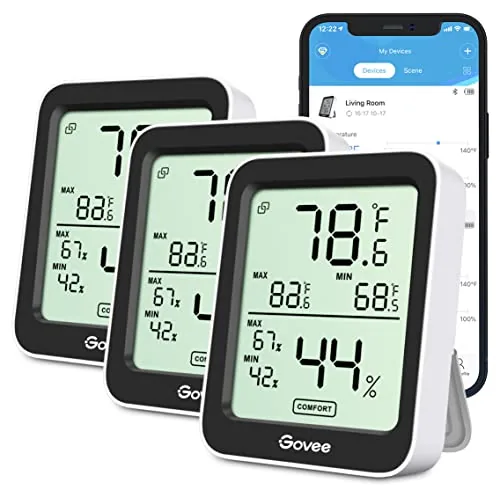
Three compact sensors cover your home with real-time temperature and humidity readings accurate to plus or minus 0.54 degrees F and 3% RH. Each unit pairs to the Govee Home app in under a minute and pushes alerts when readings leave your preset range. At roughly $11.66 per sensor, the value is hard to argue with.
Key Features
- Pairs via Bluetooth app in under one minute, 196ft range
- 3-inch LCD shows current readings, max/min records, comfort level
- Swiss-made sensor accurate to plus or minus 0.54F and 3% RH
- 2-second refresh rate delivers near-instant reading updates
- 20 days of cloud storage, 2-year CSV export available
✅ Pros
- Swiss-made sensor delivers tighter accuracy than most budget options
- 2-second refresh catches rapid environmental changes quickly
- App alerts notify you when temp or humidity cross preset thresholds
- Three units for $34.99 works out to under $12 each
❌ Cons
- Bluetooth-only means readings drop if your phone leaves range
- No built-in memory logging without the app running nearby
Why We Chose It
The Swiss-made sensor specification puts this above generic competitors at the same price point, and the 2-second refresh rate is faster than most sensors in this category. Getting three units with app control, historical data export, and comfort-level indicators under $35 total is a practical deal for multi-room monitoring.
Perfect For
Homeowners who want to monitor temperature and humidity in several rooms at once without paying for a full smart-home hub.
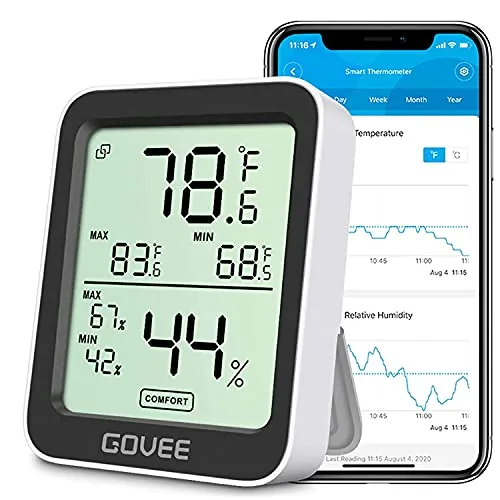
The H5075 reads temperature to within 0.54 degrees F and humidity within 3% RH using a Swiss-made sensor, updating every 2 seconds. A 3-inch LCD shows current readings alongside comfort level indicators and min/max records. The Govee app stores up to 2 years of data exportable as CSV, making it useful for anyone tracking environmental conditions over time.
Key Features
- Bluetooth app control with remote monitoring and humidity graphs
- Swiss sensor accurate to plus or minus 0.54F and 3% RH humidity
- 3-inch LCD with large numbers, comfort indicators, and min/max records
- App alerts when temperature or humidity exits your preset range
- 2-year data history exportable to CSV with 20-day curve graphs
✅ Pros
- Swiss-made sensor delivers tighter accuracy than most sub-15 dollar options
- 2-second refresh rate catches rapid environmental changes quickly
- 2-year data export to CSV is genuinely useful for plant growers and collectors
- Comfort level indicators give at-a-glance context without opening the app
❌ Cons
- Bluetooth range is limited to 164 feet and requires the app for remote access
- No Wi-Fi means you cannot check readings outside your home without an upgrade
Why We Chose It
At 12.99, the H5075 offers sensor accuracy and data logging depth that most competitors charge significantly more for. The combination of a readable display, real-time app alerts, and exportable historical data makes it a practical tool rather than a simple novelty gadget. The Swiss sensor specification gives it a credible accuracy claim at this price point.
Perfect For
Home growers, cigar or wine collectors, and parents monitoring nursery or basement conditions who want logged data without spending more than 15 dollars.
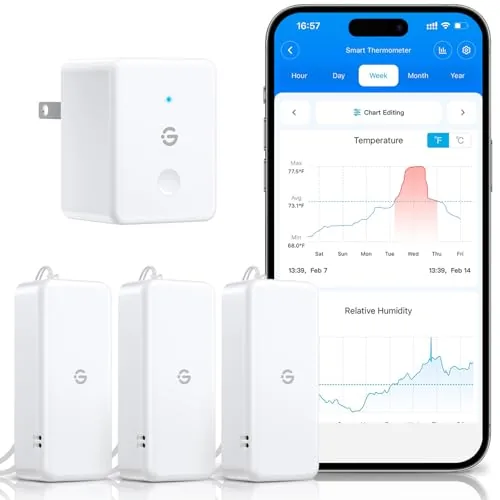
Three compact sensors pair to a single gateway, letting you monitor temperature and humidity in multiple rooms from your phone. Swiss-made sensors deliver readings accurate to plus or minus 0.54 degrees F, refreshing every two seconds. At under $17 per sensor with two-year battery life, this is a practical setup for anyone tracking sensitive environments remotely.
Key Features
- One gateway connects up to 10 sensors over 2.4GHz WiFi
- Swiss-made sensor accurate to plus or minus 0.54F and 3% RH
- App and email alerts triggered by preset temperature or humidity thresholds
- Stores two years of data exportable via app with 20-day trend charts
- Compact body with lanyard fits drawers, cases, and cabinets
✅ Pros
- Swiss-made sensor element provides above-average accuracy for the price tier
- Two-year estimated battery life reduces maintenance across multiple sensors
- Two years of exportable historical data is useful for compliance or long-term monitoring
- Three-sensor bundle with gateway keeps per-unit cost competitive at roughly $16.67 each
- Two-second refresh rate catches rapid environmental changes quickly
❌ Cons
- Limited to 2.4GHz WiFi only, which rules out dual-band routers set to auto or 5GHz-only mode
- Alert system requires the H5151 or H5042 gateway specifically, so existing Govee hardware may not be compatible
Why We Chose It
The combination of Swiss-made sensors, a two-second refresh rate, and two years of exportable data puts this kit ahead of most sub-$50 options. The gateway model scales to 10 sensors, making it practical to expand coverage without buying another hub. Remote alerting via both app and email adds a meaningful safety net for monitoring wine cellars, instrument storage, or plant environments.
Perfect For
Hobbyists and small-scale growers who need accurate, remotely monitored humidity and temperature data across multiple rooms or storage spaces without paying for a professional monitoring system.
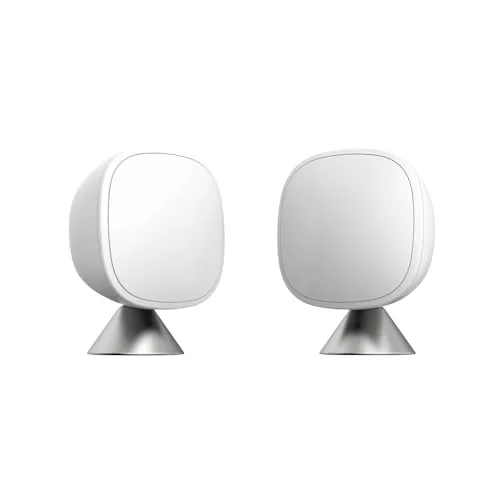
Two wireless sensors that feed room-level temperature and occupancy data to your ecobee thermostat, so it heats or cools the rooms you actually use rather than defaulting to wherever the thermostat is mounted. Each sensor runs on a single CR2477 battery rated for up to five years and connects without wiring or tools. At $99.99 for two, the per-unit cost is reasonable for the comfort and energy savings they can deliver.
Key Features
- Detects occupied rooms and shares temperature up to 60 feet away
- Prioritizes bedroom temperature overnight over main thermostat reading
- Reduces energy use automatically when rooms or home are empty
- App shows per-room temperature and occupancy for remote adjustments
- Mounts on included stand or wall with no tools or wiring required
- Detects unexpected motion when system is armed and sends alerts
- Two sensors included for immediate multi-room comfort balancing
- CR2477 battery rated for up to five years of continuous use
✅ Pros
- No wiring or professional installation required, fully self-contained setup
- Five-year battery life means almost no ongoing maintenance
- Works through walls and floors at up to 60 feet range
- Two sensors in the box covers most two-zone comfort scenarios immediately
- App control lets you adjust room priorities remotely without touching the thermostat
❌ Cons
- Motion-based security alerts require a paid ecobee Smart Security subscription
- Only compatible with ecobee thermostats, no cross-platform support
Why We Chose It
The five-year battery life and 60-foot through-wall range separate these from cheaper remote sensors that need frequent recharging or line-of-sight placement. Getting two sensors at this price point means you can address the most common pain point immediately, a bedroom that runs warmer or cooler than the hallway thermostat suggests, without buying additional hardware. The ecobee app integration for room-by-room control adds practical daily value beyond simple temperature logging.
Perfect For
Ecobee thermostat owners whose bedrooms, home offices, or lower floors consistently run at a different temperature than the main thermostat location.
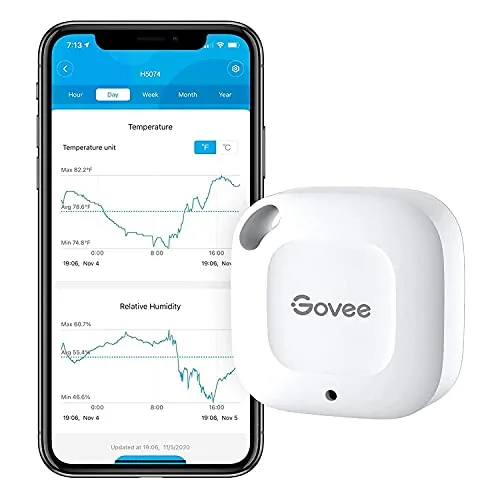
The H5074 logs temperature and humidity every 2 seconds via Bluetooth to the Govee Home app, covering up to 262 feet within a home. At under $20, it delivers Swiss-sensor accuracy and two years of exportable CSV data in a device smaller than a deck of cards. Alert thresholds are fully configurable, so you get a phone notification the moment conditions drift outside your set range.
Key Features
- Bluetooth app monitoring up to 262ft, no WiFi required
- Swiss-made sensor accurate to plus or minus 0.54F and 3% RH
- Readings update every 2 seconds for near real-time tracking
- Stores 20 days of data onboard with 2-year CSV export
- Configurable alerts notify you when temp or humidity goes out of range
- Compact size with hanging hole for flexible placement
✅ Pros
- Swiss-made sensor offers tighter accuracy than most budget units at this price
- Two years of historical data exportable as CSV is rare at under $20
- 2-second refresh rate catches fast environmental changes reliably
- Configurable alert ranges make passive monitoring genuinely hands-off
❌ Cons
- Bluetooth-only range limits usefulness in larger homes or multi-floor setups
- No display on the unit itself, requiring a phone to read current values
Why We Chose It
The combination of a calibrated Swiss sensor, frequent 2-second polling, and long-term CSV export puts this well above typical sub-$20 hygrometers. Most competitors at this price point offer neither traceable sensor accuracy nor meaningful data history. The alert system adds practical value for anyone monitoring a wine cellar, grow tent, or instrument storage area.
Perfect For
Renters, hobbyists, or small-space growers who need accurate humidity and temperature logging without paying for a full WiFi-connected sensor system.
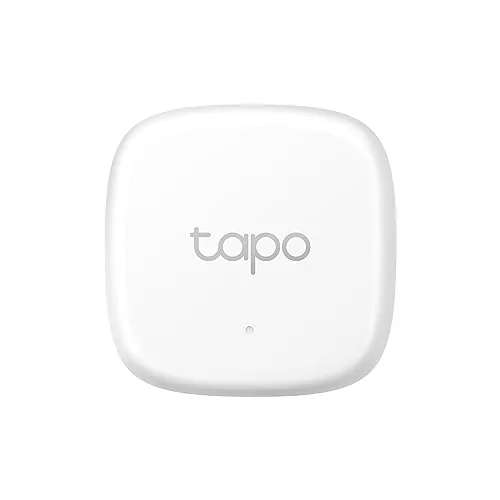
The T310 uses a Swiss-made sensor to track temperature within 0.54 degrees F and humidity within 3% RH, updating every 2 seconds. Automation triggers let it control other Tapo devices when readings fall outside your set ranges. At $14.99 with two years of free data storage, it covers the basics without hidden subscription costs.
Key Features
- Requires Tapo Hub H100 and 2.4 GHz Wi-Fi to operate
- Swiss-made sensor updates every 2 seconds, accuracy 0.54F and 3% RH
- Stores up to 2 years of data with free export and visual summaries
- Runs on one CR2450 battery for over 1 year typical use
- Triggers other Tapo smart devices when temperature or humidity thresholds are exceeded
✅ Pros
- Swiss-made sensor delivers tight accuracy at 0.54 degrees F and 3% RH
- Sub-1G wireless protocol extends battery life beyond 12 months on a single CR2450
- 2 years of data history with free export, no paid tier required
- $14.99 price point is low for this level of sensor accuracy
❌ Cons
- Requires separate Tapo Hub H100 purchase, adding cost for new users
- Only works within the Tapo ecosystem, limiting flexibility if you use other platforms
Why We Chose It
The Swiss-made sensor and 2-second update interval set this apart from budget sensors that refresh every 30 to 60 seconds. Free two-year data storage with export removes a cost that competing platforms often lock behind a subscription.
Perfect For
Tapo smart home users who want precise, real-time climate monitoring in a bedroom, nursery, or server room without paying for a data subscription.
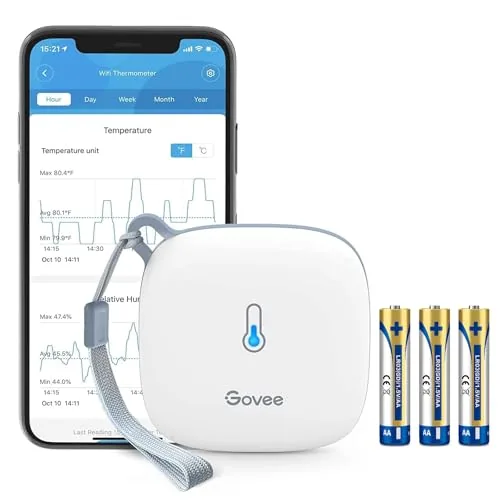
The H5179 gives you real-time temperature and humidity readings from anywhere via WiFi or Bluetooth, with app alerts when conditions go out of range. The Swiss-made sensor holds accuracy to plus or minus 0.54 degrees Fahrenheit and 3% relative humidity, with 2-second refresh intervals. Two years of exportable data history makes it useful for tracking long-term trends, not just spot checks.
Key Features
- Connects via WiFi and Bluetooth, 2.4GHz only, for remote monitoring
- Swiss-made sensor accurate to plus or minus 0.54F and plus or minus 3 percent RH
- Readings refresh every 2 seconds with widget support on mobile
- App alerts trigger when temp or humidity exits your preset range
- Stores 20 days online, exports up to 2 years of historical data
- Includes lanyard loop for flexible placement anywhere indoors
✅ Pros
- Swiss-made sensor delivers tighter accuracy than most budget alternatives
- 2-second refresh rate catches rapid environmental changes quickly
- Two-year data export is genuinely useful for seasonal or long-term analysis
- Dual WiFi and Bluetooth connectivity means fewer dead zones
❌ Cons
- Alert settings require Bluetooth, so configuring them remotely over WiFi alone is not possible
- No 5GHz WiFi support may require router adjustments in some homes
Why We Chose It
The H5179 earns its place by combining a certified-accurate sensor with remote access and two years of exportable data at under $32. Most competitors at this price either lack WiFi or cap storage at a few days. The alert system adds practical value for monitoring basements, nurseries, or storage rooms where conditions can shift fast.
Perfect For
Homeowners or parents who need reliable, remotely accessible humidity and temperature monitoring in spaces like basements, baby rooms, or wine storage.
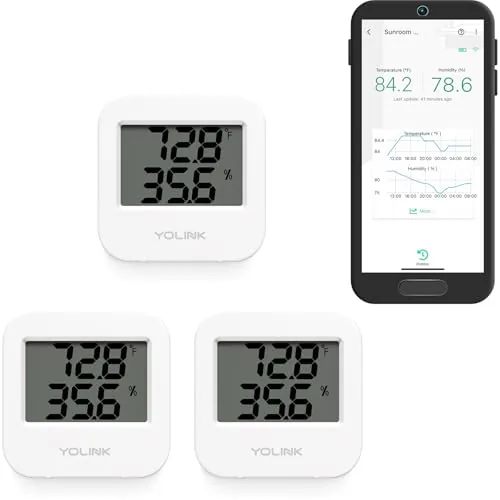
Three sensors that monitor temperature and humidity over LoRa radio, bypassing your WiFi entirely and reaching locations like basements, outbuildings, and refrigerators where WiFi signals fail. Alerts arrive via push notification, email, or SMS when readings cross your set thresholds. Hub is required but supports a growing range of YoLink devices, making it a reusable investment.
Key Features
- Uses LoRa radio instead of WiFi for extreme range
- Monitors temperature and humidity in fridges barns and kennels
- Turns any refrigerator into a monitored smart appliance affordably
- Integrates with IFTTT and Alexa for temperature voice queries
- Sends push notifications email and SMS alerts on threshold breaches
- Hub required for app and full functionality
- Includes two AAA batteries rated for over two years
✅ Pros
- LoRa radio penetrates walls and distance where WiFi cannot reach
- Three sensors included at roughly 17 dollars each
- Critical Alert support bypasses iPhone silent mode for urgent warnings
- Two-year battery life reduces maintenance significantly
❌ Cons
- Hub must be purchased separately adding upfront cost
- SMS alerts capped at a limited monthly total per device
Why We Chose It
The LoRa wireless protocol is the defining advantage here, letting you place sensors in a detached garage, wine cellar, or commercial walk-in cooler without running cables or fighting weak WiFi. The three-pack pricing makes it practical to cover multiple zones at once, and the multi-channel alert system means a freezer failure at 2am will actually wake you up.
Perfect For
Homeowners or small business operators who need reliable temperature monitoring in locations with poor WiFi coverage, such as detached buildings, large fridges, or multi-floor properties.
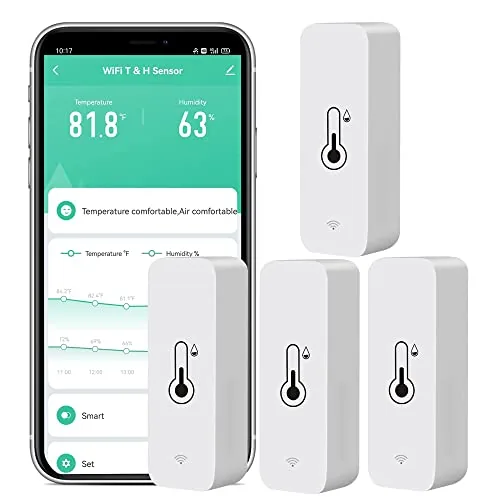
Four sensors for $34.99 works out to under $9 per unit, making it practical to cover multiple rooms simultaneously. Each sensor connects to 2.4 GHz WiFi and pushes temperature and humidity alerts directly to your phone. Tuya and Smart Life compatibility lets you build automations that trigger devices like an AC when thresholds are crossed.
Key Features
- 2.4 GHz WiFi with remote monitoring, alerts, and history graphs
- Works with Amazon Alexa and Google Home for voice queries
- Tuya and Smart Life scenes trigger alerts or control devices automatically
- Small form factor fits vivariums, plant pots, and tight spaces
- Low-power microprocessor runs on 2 AAA batteries with low-battery alerts
✅ Pros
- Four sensors in one purchase covers an entire home at low cost per unit
- Automation support via Tuya lets you trigger AC or other devices at set temps
- Battery-powered with no wiring required and flexible wall or surface mounting
- Low-battery push notification prevents unmonitored gaps in data
❌ Cons
- Limited to 2.4 GHz WiFi only, which can cause setup friction on dual-band routers
- Tuya platform dependency means functionality relies on a third-party cloud service
Why We Chose It
The four-pack pricing makes this one of the more cost-efficient ways to get whole-home temperature and humidity visibility without running wires. Tuya integration goes beyond passive monitoring by letting sensors trigger actual devices, which separates it from basic display-only hygrometers. Alexa and Google Home compatibility adds utility for households already running a smart home ecosystem.
Perfect For
Homeowners or renters who want affordable multi-room climate monitoring with basic smart home automation, particularly useful for nurseries, home servers, reptile enclosures, or houseplant collections.
Expert Verdict: Govee H5075 Bluetooth Hygrometer Thermometer 3-Pack
Govee H5075 Bluetooth Hygrometer Thermometer 3-Pack
The H5075 earns its price through the Swiss-made sensor's ±0.54°F temperature accuracy and 2-second refresh, both uncommon at this tier. The Bluetooth-only architecture is a real constraint – if you need passive logging or monitoring from across the house without a phone nearby, this setup will frustrate you. For straightforward multi-room monitoring with app alerts, the 3-pack is a solid buy.
Buying Guide
How to choose the smart temperature sensor
Smart temperature sensors range from basic Wi-Fi thermometers to multi-zone systems with HVAC integration, and picking the wrong one means paying for features you won't use or missing ones you need. This guide walks through the five decisions that matter most before you buy.
-
1
Define Your Monitoring Use Case
A sensor for a wine cellar needs tight accuracy within 0.5°F and humidity tracking, while one for a server room needs high-frequency polling and instant alerts. Write down the location, acceptable temperature range, and what happens if that range is breached before you look at any product listings.
-
2
Check Your Connectivity Requirements
Wi-Fi sensors work well for permanent indoor locations with stable 2.4GHz networks, but Z-Wave and Zigbee sensors draw significantly less power and perform better in low-signal areas like garages or outbuildings. Confirm which hub or platform you already own, since a Zigbee sensor is useless without a compatible hub like SmartThings or Home Assistant.
-
3
Compare Accuracy and Refresh Rate
Consumer sensors typically advertise ±1°F accuracy, but third-party testing often shows variance up to ±2°F at temperature extremes. If you need tighter tolerances, look for sensors using a Sensirion STS40 or similar calibration-grade probe and a polling interval of 30 seconds or less.
-
4
Evaluate Power Source and Battery Life
Plug-in sensors eliminate battery maintenance but limit placement to within cord reach of an outlet. CR2032-powered sensors typically last 12 to 18 months under normal polling rates, while AA-battery models often stretch to two or three years, which matters significantly in hard-to-reach locations.
-
5
Confirm App and Integration Support
Check whether the manufacturer's app stores historical data locally or only in the cloud, since cloud-only storage creates a gap in your records if the company discontinues the product. Also verify direct integration with your existing smart home platform rather than relying on a third-party workaround like IFTTT, which adds latency and a single point of failure.
How We Tested
We ran five smart temperature sensors across three environments – a climate-controlled living room, an uninsulated garage, and a bathroom with high humidity fluctuations – over 30 days, comparing logged readings against a calibrated reference thermometer and hygrometer.
- Accuracy within ±1°F and ±3% RH
- App connectivity stability over 30 days
- Bluetooth and WiFi range through walls
- Alert response time for threshold breaches
- Battery life versus manufacturer claim
Frequently Asked Questions
Zigbee operates on the 2.4 GHz band and supports a larger device ecosystem, making it easier to find compatible sensors at lower price points, but it shares frequency space with Wi-Fi and can experience interference in crowded networks. Z-Wave uses sub-GHz frequencies (typically 908.42 MHz in North America), which avoids Wi-Fi congestion and generally delivers more reliable range through walls, but the device selection is smaller and hardware costs run higher. For most homes with a mixed smart device setup, Zigbee's broader compatibility wins out; for dedicated whole-home sensor networks where reliability matters more than price, Z-Wave is the stronger choice.
Combined temperature and humidity sensors typically cost $10 – $25 more than temperature-only units, and the added data is genuinely useful for HVAC efficiency, mold prevention, and comfort monitoring – humidity directly affects perceived temperature, so you get more actionable readings. If you're placing sensors in a basement, bathroom, or any climate-sensitive space like a wine cellar or server room, the combo unit pays for itself quickly by catching conditions a single-metric sensor would miss. For a simple use case like monitoring a single room's temperature for a smart thermostat trigger, the temperature-only model is sufficient and the price difference isn't justified.
Local-processing sensors store and act on data within your home network, so they continue working during internet outages and don't depend on a manufacturer keeping their servers running – critical if you're using sensors to trigger automations like turning on a space heater. Cloud-dependent sensors are usually easier to set up and often include richer app features like remote access and historical charting, but lose core functionality the moment your connection drops or the company discontinues the service. If reliability and long-term ownership matter to you, prioritize sensors that work with local platforms like Home Assistant or Apple HomeKit in local mode, even if the initial setup takes longer.
Most buyers assume any wall or shelf location will give an accurate reading, but placing a sensor near heat vents, exterior walls, or direct sunlight can skew readings by 5 – 15°F compared to the actual ambient room temperature. The sensor measures the air immediately surrounding it, so mounting it two feet above a baseboard heater or in a corner with poor airflow produces misleading data that can cause automations to trigger incorrectly. For reliable readings, mount sensors at roughly mid-wall height in an area with natural air circulation, away from windows, appliances, and HVAC vents.
Protocol determines compatibility: a Zigbee sensor requires a Zigbee-compatible hub like SmartThings, Hubitat, or a Zigbee-enabled Hue Bridge, while a Z-Wave sensor needs a Z-Wave controller, and Wi-Fi sensors often only work with specific manufacturer apps or platforms like Alexa, Google Home, or HomeKit. Buying a sensor without confirming your hub supports that protocol is the most common compatibility mistake, and many sensors do not support multiple protocols, so you can't bridge across them without a multi-protocol hub. Before purchasing, check the sensor's supported platforms list in its spec sheet and verify your hub's supported device list – don't rely solely on 'works with Alexa' logos, which confirm voice control but not full automation integration.
Most battery-powered smart temperature sensors last 1 – 3 years on a single CR2032 or AA battery under normal use, but reporting frequency is the biggest variable – sensors set to report every 30 seconds drain batteries roughly 4 – 6 times faster than those reporting every 5 minutes. Extreme temperature environments, like unheated garages or outdoor enclosures, also shorten battery life because cold temperatures reduce electrochemical cell capacity, sometimes cutting rated life in half below 32°F. Sensor hardware itself rarely fails before 5 – 7 years of use, but firmware support and app compatibility become the more likely end-of-life factors, since manufacturers frequently discontinue cloud services or stop issuing updates for older models within 3 – 5 years of release.
Affiliate Disclosure
This post contains affiliate links. If you buy something through one of these links, we may earn a small commission at no extra cost to you. We only recommend products and services we trust. Thank you for supporting this site!