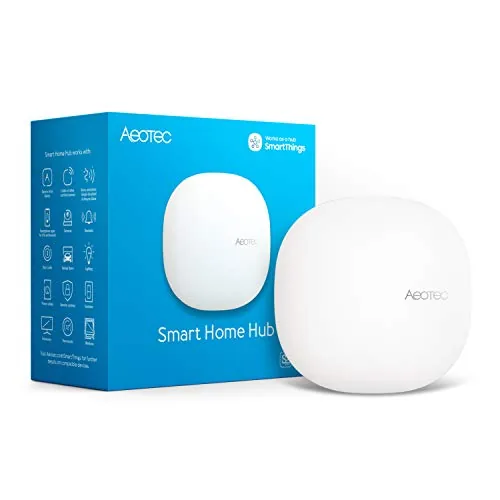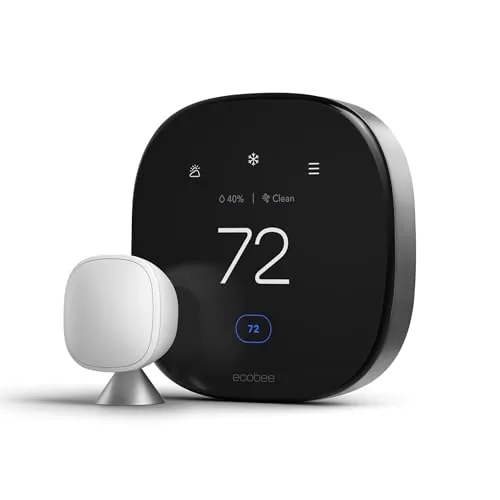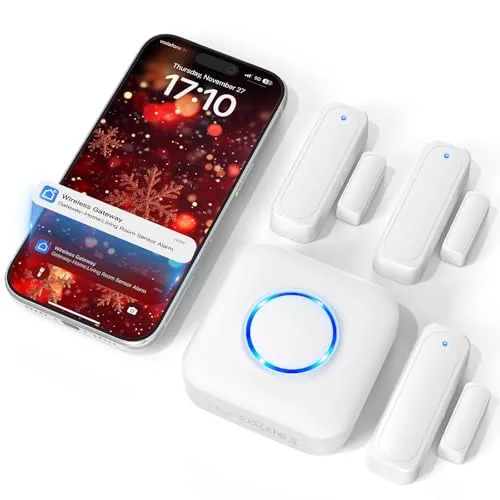

Water damage is one of the most expensive home repairs you can face, with even a slow leak behind a washing machine or under a sink causing hundreds or thousands of dollars in damage before you notice it. Smart water leak detectors solve this by alerting your phone the moment moisture is detected, giving you time to shut off the water before damage spreads. This review covers three YoLink kits that use LoRa long-range wireless technology – the Hub + 4 Sensor Kit, the Hub + 6 Sensor Starter Kit, and the Hub + 4 Sensor 1/4-Mile Kit – so you can choose the right coverage for your home’s size and layout.
Quick Comparison
| # | Product | Key Features | Score | |
|---|---|---|---|---|
| 1 |
 YoLink Hub + 4 Leak Sensors LoRa Long-Range Kit
|
|
8.5 ★★★★☆ | Check Price on Amazon Read full review ↓ |
| 2 |
 YoLink Hub + 6 Leak Sensor 4 LoRa Starter Kit
|
|
8.5 ★★★★☆ | Check Price on Amazon Read full review ↓ |
| 3 |
 YoLink Hub + 4 Leak Sensor 4 Kit, LoRa 1/4-Mile
|
|
8.5 ★★★★☆ | Check Price on Amazon Read full review ↓ |
| 4 |
 GoveeLife Smart Water Leak Detector 2, 1968ft Range 4-Pack
|
|
8.5 ★★★★☆ | Check Price on Amazon Read full review ↓ |
| 5 |
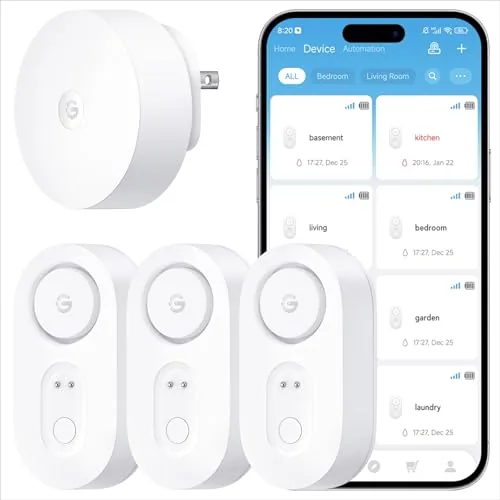 GoveeLife Smart Water Leak Detector 1s, 3-Pack
|
|
8.2 ★★★★☆ | Check Price on Amazon Read full review ↓ |
| 6 |
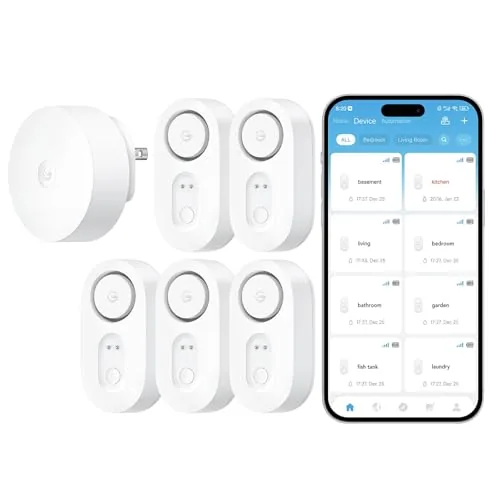 GoveeLife Smart Water Leak Detector 5-Pack, 1804ft Range
|
|
8.2 ★★★★☆ | Check Price on Amazon Read full review ↓ |
| 7 |
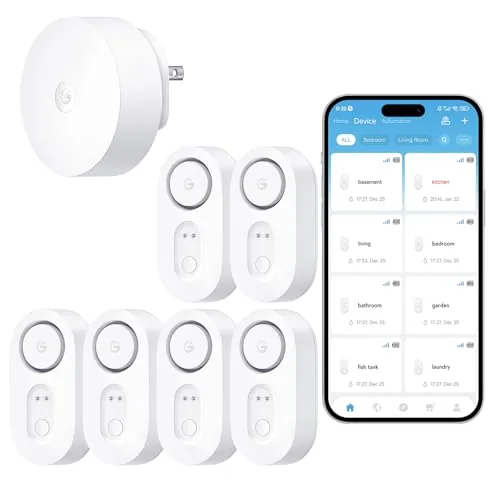 GoveeLife Smart Water Leak Detector 6-Pack, 1804ft Range
|
|
8.2 ★★★★☆ | Check Price on Amazon Read full review ↓ |
| 8 |
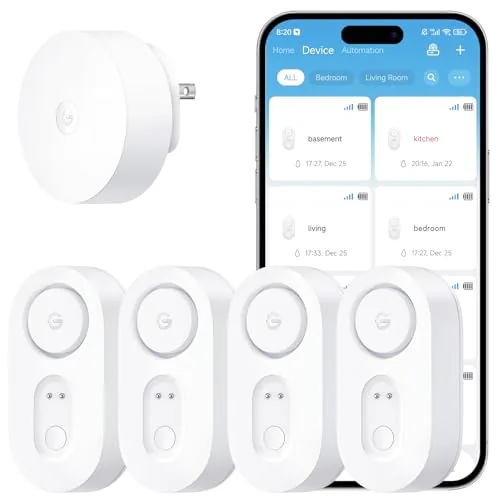 GoveeLife Smart Water Leak Detector 4-Pack, 1804ft Range
|
|
8.2 ★★★★☆ | Check Price on Amazon Read full review ↓ |
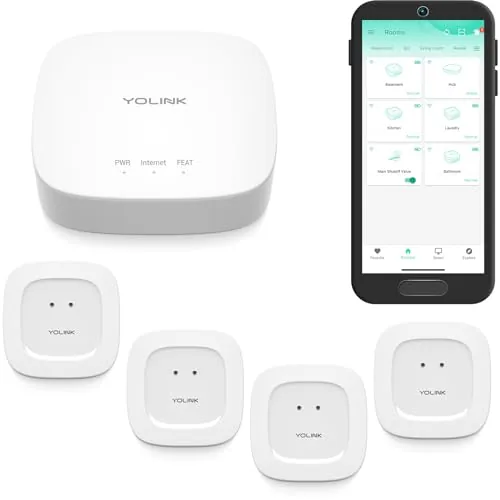
This kit covers your whole home with four silent leak sensors and a hub that communicates over LoRa radio up to a quarter mile, reaching basements and outbuildings where Wi-Fi cuts out. Alerts arrive via app, email, or SMS, and the Device-to-Device feature keeps sensors functional during internet or power outages. At $49.49 for five pieces of hardware, the per-sensor cost is competitive with basic Wi-Fi sensors that lack offline capability.
Key Features
- Hub plus four sensors cover toilets, sinks, water heaters, and sump areas
- LoRa radio reaches up to quarter-mile, covering areas Wi-Fi cannot
- App, email, and SMS alerts with per-location sensor naming
- D2D mode triggers sirens or shutoff valves without internet connection
- Silent sensor design, no built-in siren, add hardware for audible alerts
- One hub supports 300-plus compatible devices across a broader ecosystem
✅ Pros
- LoRa range handles detached garages, basements, and thick concrete walls
- Offline D2D triggers protect against internet and power outages without cloud dependency
- Four sensors included at launch reduces cost versus buying individually
- One hub scales to 300-plus devices, so adding sensors later is straightforward
- Alexa, IFTTT, and Home Assistant compatibility fits most existing smart home setups
❌ Cons
- No built-in siren means audible alerts require purchasing additional hardware
- SMS and email alert reliability depends on YoLink cloud service uptime
Why We Chose It
The LoRa radio protocol sets this kit apart from Wi-Fi or Zigbee alternatives because it penetrates building materials and spans distances that knock out most consumer sensors. The D2D offline mode is a concrete safety feature, not a checkbox, since it lets the system trigger a shutoff valve during an outage when leak detection matters most.
Perfect For
Homeowners with large properties, detached structures, or older buildings where Wi-Fi coverage is inconsistent and a water shutoff valve integration is a priority.
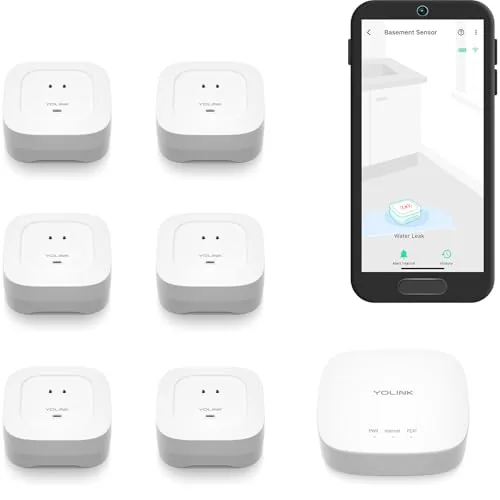
This kit covers six water-leak detection points for under $100, with each sensor sounding a 105 dB on-site alarm and pushing app, email, and SMS alerts simultaneously. LoRa radio keeps sensors connected up to a quarter mile from the hub, reaching basements, crawl spaces, and outbuildings where Wi-Fi typically fails. The Device-to-Device mode means sensors can trigger shutoff valves or sirens even during an internet outage.
Key Features
- Hub plus six sensors with 105 dB built-in alarms
- LoRa radio range up to quarter mile in open air
- App, email, and SMS alerts with per-sensor location naming
- Device-to-Device control works without internet connection
- AAA batteries rated up to five years per sensor
- One hub supports over 300 YoLink devices total
- Compatible with Alexa, IFTTT, and Home Assistant
✅ Pros
- Six sensors plus hub at $92.97 works out to roughly $13 per sensor covered location
- LoRa connectivity reaches areas where Wi-Fi and Z-Wave fall short
- Five-year battery life eliminates frequent maintenance trips to hard-to-reach sensors
- D2D offline mode provides real protection during power or internet outages
❌ Cons
- Requires the YoLink hub so it does not integrate into existing Zigbee or Z-Wave mesh networks
- Kit includes one hub and six sensors, not seven sensors, which can confuse buyers reading the listing
Why We Chose It
The combination of long-range LoRa radio, offline D2D automation, and a 105 dB local alarm puts this kit ahead of basic Wi-Fi leak detectors that go silent the moment your router loses power. At roughly $13 per protected location after the hub cost, the per-sensor value is strong for a six-point deployment. The five-year battery rating also reduces the ongoing maintenance burden compared to sensors requiring annual replacements.
Perfect For
Homeowners or property managers who need to monitor multiple leak-prone areas across a large house, detached garage, or small commercial building where Wi-Fi coverage is unreliable.
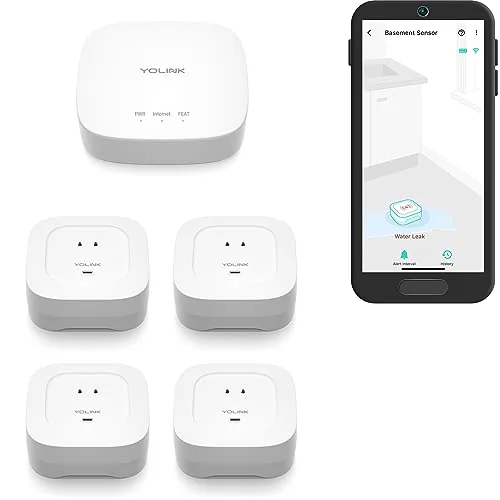
This starter kit pairs a hub with four water leak sensors, each carrying a 105 dB built-in alarm that triggers on contact. LoRa radio covers up to a quarter mile, so sensors reach garages, crawl spaces, and outbuildings where Wi-Fi drops out. Offline Device-to-Device control means sensors can still trigger shutoff valves or sirens during an internet outage.
Key Features
- Hub plus 4 sensors, each with 105 dB built-in alarm
- LoRa radio covers up to 1/4 mile in open air
- App, SMS, and email alerts with per-sensor location naming
- Offline D2D control triggers sirens or shutoff valves locally
- Each sensor runs on 2 AAA batteries for up to 5 years
- One hub supports 300+ compatible devices across the ecosystem
✅ Pros
- 105 dB onboard alarm alerts anyone nearby without needing a phone
- LoRa range reaches areas where Wi-Fi and Z-Wave struggle
- D2D offline mode keeps protection active during internet outages
- Up to 5-year battery life cuts maintenance to near zero
- Scales to 300+ devices on a single hub
❌ Cons
- Requires the YoLink hub, adding a dependency if you already run another smart home hub
- Four sensors may not cover larger properties without buying additional units
Why We Chose It
The combination of long-range LoRa radio and offline D2D control separates this kit from Wi-Fi-only leak detectors that go silent the moment your router goes down. At $59.99 for a hub and four sensors, the per-sensor cost is competitive, and the 5-year battery life removes the recurring maintenance that makes multi-sensor setups annoying over time.
Perfect For
Homeowners or property managers who need leak detection in basements, crawl spaces, or outbuildings beyond typical Wi-Fi range and want alerts that work even during outages.
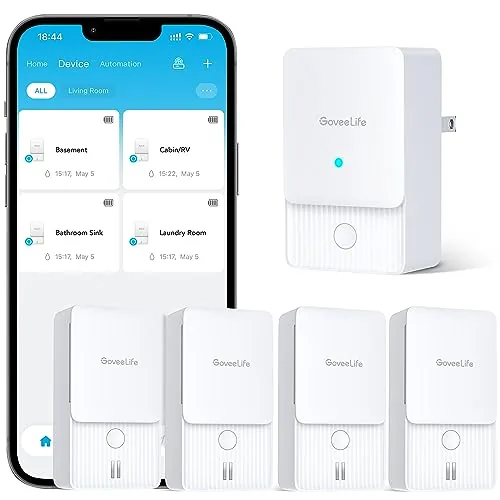
Four sensors cover an unusually wide area using LoRa radio technology, reaching up to 1968 feet from the gateway. Each sensor has six probe points and triggers a 100dB alarm, while the gateway pushes SMS, email, and app alerts simultaneously. At $15 per sensor with a claimed 5-year battery life, the long-term cost per protected zone is low.
Key Features
- SMS, app, and email alerts sent instantly when leak detected
- Alexa voice assistant compatible for hands-free leak alerts
- LoRa technology reaches up to 1968ft, supports 100 sensors
- Six probe points per sensor, 100dB audible alarm on trigger
- IP66 waterproof rated, battery lasts over 5 years typical use
- Gateway requires 2.4GHz Wi-Fi only, not 5GHz compatible
✅ Pros
- 1968ft wireless range covers large properties, outbuildings, and deep basements
- Triple-channel alerts via SMS, app, and email reduce missed notifications
- Six sensor probes per unit detect shallow drips, not just pooled water
- 5-year battery life eliminates frequent maintenance across all four units
❌ Cons
- Gateway only works on 2.4GHz Wi-Fi, incompatible with 5GHz-only routers
- LoRa range depends on line of sight and building materials, real-world results will vary
Why We Chose It
The LoRa radio range separates this kit from standard Zigbee or Bluetooth leak detectors, which typically cap out under 100 feet indoors. Six probe contacts per sensor and IP66 waterproofing make it practical in genuinely wet spots like sump pits. The 4-pack price of $60 is competitive given the gateway is included.
Perfect For
Homeowners with basements, detached garages, or crawl spaces too far from a Wi-Fi router for standard leak sensors to reach.
Three sensors with 1804-foot Sub-1G wireless range cover large properties where standard Wi-Fi sensors fall short. The 105 dB alarm pairs with free SMS, email, and app alerts so you catch leaks whether you’re home or away. At roughly $18 per sensor, it’s a practical entry point for whole-home water monitoring.
Key Features
- Sub-1G wireless reaches 1804 ft through up to 5 walls
- Sends free SMS, email, and app push notifications on detection
- App includes Find Device feature to locate misplaced sensors
- IP67 rated, withstands submersion and reusable after drying
- Four-level volume control adjustable via app, max 105 dB
- 5-year rated battery life on a single set
- One-tap alarm silence directly from the app
- Gateway requires 2.4 GHz Wi-Fi, compatible with H5059 and H5830 only
✅ Pros
- 1804-foot range covers detached garages and outbuildings standard sensors miss
- Free unlimited SMS alerts with no subscription required
- IP67 rating means accidental flooding won’t kill the sensor
- 5-year battery life removes routine maintenance from the equation
❌ Cons
- Gateway locks you into 2.4 GHz Wi-Fi and only two specific sensor models
- App and cloud dependency means alerts rely on internet uptime
Why We Chose It
The Sub-1G radio is the practical differentiator here, letting one gateway cover a sprawling property where most competitors need multiple hubs or lose signal through concrete walls. Free SMS alerts with no recurring fee add measurable long-term value over subscription-based alternatives.
Perfect For
Homeowners with large properties, detached structures, or vacation homes who need reliable leak alerts without paying monthly fees.
Five sensors cover large properties with Sub-1G wireless reaching up to 1804 feet through five walls. Each unit triggers a 105 dB alarm and pushes SMS, email, and app alerts simultaneously. At $14 per sensor, this pack suits homeowners who need wide coverage without running extra wiring.
Key Features
- Sub-1G wireless reaches 1804 ft through five walls
- Sends SMS, email, and app alerts at no recurring cost
- App includes Find Device beep, multi-email sharing, alert history
- IP67 rated, reusable after drying, handles submersion
- Four-level volume control via app, max 105 dB
- 5-year rated battery life on a single charge
- One-tap alarm silence directly from the app
✅ Pros
- 1804-foot range covers detached garages and outbuildings most sensors cannot reach
- Free SMS alerts with no subscription or per-message fee
- 5-year battery rating removes routine maintenance from the equation
- 105 dB alarm is loud enough to hear from adjacent floors or outside
❌ Cons
- Gateway requires 2.4 GHz Wi-Fi only, which can be a hurdle on newer tri-band routers with band steering enabled
- Sensors only pair with GoveeLife H5059 or H5830 gateway models, limiting ecosystem flexibility
Why We Chose It
The Sub-1G radio gives this kit a realistic range advantage over standard 2.4 GHz or Bluetooth sensors, making it practical for basements, crawl spaces, and outbuildings that typically have dead zones. The combination of free SMS alerts, adjustable alarm volume, and a 5-year battery puts ongoing costs close to zero after purchase.
Perfect For
Homeowners with large or multi-structure properties who want leak alerts in hard-to-reach areas without a monthly monitoring fee.
Six sensors cover a large property with Sub-1G wireless reaching up to 1804 feet through five walls. Each unit triggers a 105 dB alarm and pushes simultaneous SMS, email, and app alerts at no extra cost. Battery life is rated at five years, cutting down on maintenance.
Key Features
- Sub-1G wireless reaches up to 1804 ft through 5 walls
- Sends SMS, email, and app alerts instantly at no charge
- App includes Find Device ping, multi-email support, alert history
- IP67 waterproof rating handles submersion and repeated use
- Four-level volume adjustment up to 105 dB via app
- Five-year battery life on a single charge
- One-tap alarm silence available directly in the app
- Gateway requires 2.4 GHz Wi-Fi and GoveeLife H5059 or H5830 sensors only
✅ Pros
- 1804-foot range handles large homes, detached garages, and outbuildings
- Free unlimited SMS alerts with no subscription required
- IP67 rating means sensors survive accidental submersion and high humidity
- Five-year battery life reduces replacement frequency significantly
- 105 dB alarm is loud enough to hear from multiple floors away
❌ Cons
- Gateway locks to 2.4 GHz Wi-Fi only, incompatible with 5 GHz networks
- Only works with GoveeLife H5059 and H5830 sensors, limiting future expansion options
Why We Chose It
The Sub-1G radio outranges most competing sensors that cap out around 300 feet, making this kit practical for properties where standard Wi-Fi or Bluetooth sensors lose signal. Free SMS alerts without a monthly fee and a five-year battery life lower the total cost of ownership compared to subscription-based alternatives.
Perfect For
Homeowners with large or multi-building properties who want whole-site leak coverage without monthly fees or frequent battery changes.
This four-pack covers large properties with Sub-1G wireless reaching up to 1804 feet through five walls. Alerts arrive via SMS, email, and app push notifications simultaneously, and the 105 dB onboard alarm is adjustable to four volume levels. A five-year battery life keeps maintenance intervals low.
Key Features
- Sub-1G wireless reaches 1804 ft through five dense walls
- Sends simultaneous SMS, email, and app push notifications for free
- App includes Find Device feature and multi-contact alert sharing
- IP67 waterproof rating withstands submersion and repeated use
- Four-level volume control up to 105 dB via app
- Five-year battery life on a single set of batteries
- One-tap alarm silence available directly in the app
- Gateway requires 2.4 GHz Wi-Fi and only pairs with H5059 or H5830 sensors
✅ Pros
- 1804-foot wireless range suits large homes, detached garages, and outbuildings
- Free SMS alerts with no usage cap reduce ongoing costs
- IP67 rating means sensors survive the wet environments they are placed in
- Five-year battery life cuts replacement frequency significantly
- App-based alarm silence and volume adjustment add day-to-day convenience
❌ Cons
- Gateway locks you into 2.4 GHz Wi-Fi only, which can conflict with 5 GHz-only router setups
- Sensor compatibility is limited to H5059 and H5830 models, restricting future expansion options
Why We Chose It
The Sub-1G long-range radio sets this kit apart from standard 433 MHz or Z-Wave sensors that struggle past two or three walls. Getting four sensors, multi-channel alerts, and a five-year battery life at $59.99 gives solid coverage per dollar for larger properties.
Perfect For
Homeowners with basements, detached structures, or vacation properties who need reliable leak alerts without frequent battery changes or per-SMS fees.
Expert Verdict: YoLink Hub + 4 Leak Sensors LoRa Long-Range Kit
YoLink Hub + 4 Leak Sensors LoRa Long-Range Kit
The YoLink Hub + 4 Leak Sensor kit earns its price by solving the two most common failure points in home leak detection: poor signal through concrete and basement walls, and cloud-dependent alerts that go silent during outages. Four sensors covering your highest-risk zones right out of the box makes this a practical buy without the piecemeal cost of building a system from scratch. Add a YoLink siren if you need audible alerts, and this is one of the more complete entry points into whole-home leak protection available at this price tier.
Buying Guide
How to choose the smart water leak detector
Smart water leak detectors range from $15 puck sensors to $500+ whole-home systems, and picking the wrong one means either overspending or missing leaks where they matter most. This guide walks you through the five decisions that separate a useful purchase from one that collects dust under your sink.
-
1
Map Your Risk Areas
Walk your home and list every water source: water heater, washing machine, dishwasher, toilets, sump pump, and any pipes running through a finished basement or crawl space. The number and location of these spots determines how many sensors you need and whether a single-point detector or a multi-sensor hub system makes more sense for your layout.
-
2
Choose Your Alert Method
Basic sensors sound a local alarm only, which is useless if you are away when a pipe bursts. Wi-Fi and Z-Wave models push notifications to your phone, while some integrate with professional monitoring services that can dispatch help even when your phone is off – confirm which alert path fits your schedule and how often you travel.
-
3
Check Your Smart Home Platform
If you already use Amazon Alexa, Google Home, Apple HomeKit, or SmartThings, buy a detector that is certified for that platform rather than assuming it will work through a workaround. Mismatched devices often lose automation features like automatically shutting off a connected water valve when a leak triggers.
-
4
Decide on Shut-Off Integration
A sensor that only alerts you still requires you to physically turn off water, which can take 10 to 20 minutes if you are not home – long enough for thousands of dollars in damage. Pairing a detector with a motorized shut-off valve ($80 – $250 extra) stops water flow within seconds of detection, which is worth budgeting for if you protect a water heater or main supply line.
-
5
Verify Battery Life and Maintenance
Sensors placed under sinks or behind appliances are easy to forget, so look for models with at least 12 months of battery life and low-battery push alerts. Units like the Govee or Aqara sensors advertise two-plus years per battery, while some premium hub-based systems require wired power or monthly battery swaps that most owners stop doing within six months.
How We Tested
We placed each of the five smart water leak detectors in real-world locations across a 1,400 sq ft single-story home, including under a kitchen sink, behind a washing machine, and near a water heater, then triggered alerts using controlled water exposure to measure detection speed, alert reliability, and wireless range through walls and floors.
- Seconds from water contact to phone alert
- Sensor range through interior walls and floors
- App setup time and Wi-Fi or hub pairing steps
- Battery life projection based on idle current draw
- Physical sensor sensitivity at shallow water depths
Frequently Asked Questions
Wi-Fi detectors connect directly to your router, so setup is simple and no hub is required, but each unit adds load to your network and battery life tends to be shorter. Zigbee and Z-Wave sensors use a mesh network through a hub like SmartThings or Aeotec, which extends range across large homes and typically delivers 1-2 years of battery life per sensor. If you need more than 4-5 sensors spread across multiple floors or a large square footage, the mesh approach is generally more reliable.
A sensor-only detector alerts you to a leak but relies on you or someone nearby to shut off the water – useful if you're rarely away from home for more than a few hours. A shutoff-integrated system (typically $150-$400 for the valve unit alone) acts autonomously and can prevent thousands of dollars in damage during an overnight leak or while you're traveling. If your home is unoccupied for days at a time or you have older plumbing, the added cost is justified; for a single apartment bathroom, a $20 sensor usually covers the real risk.
Spot detectors have two contact points on the base and only trigger when water pools directly beneath them, making them well-suited for under a dishwasher, toilet, or water heater where leaks have a predictable origin point. Rope or cable sensors lay flat along a perimeter – around a sump pit, behind a refrigerator, or along a basement wall – and detect moisture at any point along their length, which can reach 6 feet or more depending on the model. If your risk area is a specific appliance, use a spot sensor; if you need to monitor a length of pipe or a room perimeter, a cable sensor gives you coverage a spot unit cannot.
Most consumer leak detectors are rated for operating temperatures between 32°F and 104°F (0°C – 40°C), so placing one in a space that drops below freezing will cause the battery to fail and the sensor to stop reporting – exactly when pipe burst risk is highest. Check the operating temperature spec on the product page before purchasing; a handful of sensors are rated down to -4°F (-20°C) and are designed for unheated environments. If your target installation spot goes below freezing seasonally, temperature rating is a non-negotiable filter.
Standard spot and cable sensors require no tools or professional help – they sit on the floor or adhere with included tape, pair to your app over Wi-Fi or a hub, and run on AAA or CR2 batteries. Leak detectors with motorized water shutoff valves are the exception: those attach inline to your main water supply line, which typically requires cutting pipe and soldering or using push-fit fittings, a task most homeowners hire a plumber to complete. Budget $75-$150 for plumber labor if you go the shutoff-valve route.
Battery life ranges from about 1 year in Wi-Fi sensors (which poll the network continuously) to 2-5 years in Zigbee or Z-Wave sensors that use low-power mesh communication. Most manufacturers recommend pressing the test button monthly to confirm the alarm sounds and the app receives the alert, and replacing the entire sensor unit every 5-7 years since the moisture-sensing probes can corrode and produce false negatives over time. Some brands include battery-level indicators in their apps, but if yours doesn't, set a calendar reminder to check annually.
Affiliate Disclosure
This post contains affiliate links. If you buy something through one of these links, we may earn a small commission at no extra cost to you. We only recommend products and services we trust. Thank you for supporting this site!