
Water damage from burst pipes or slow leaks averages tens of thousands of dollars in repairs, and most of it happens while no one is home to catch it. Smart water shutoff valves solve this by monitoring flow, detecting anomalies, and cutting your water supply automatically before a small leak becomes a flooded basement. After testing the Moen Flo 900-001 (3/4-inch), the Moen Flo 1-inch, and the Moen Flo 900-002 (1.25-inch), here’s what you need to know before buying one for your home.
Quick Comparison
| # | Product | Key Features | Score | |
|---|---|---|---|---|
| 1 |
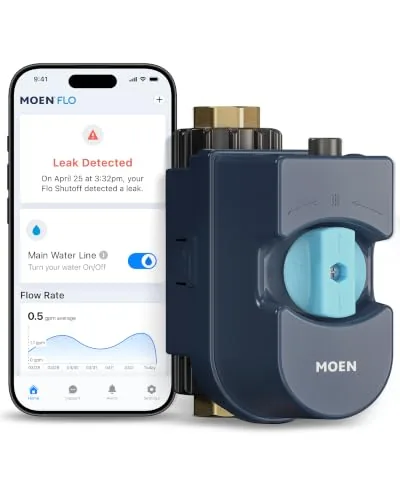 Moen Flo 900-001 3/4" Whole-Home Leak Shutoff
|
|
8.5 ★★★★☆ | Check Price on Amazon Read full review ↓ |
| 2 |
 Moen Flo 1-inch Whole-Home Auto Water Shutoff Valve
|
|
8.5 ★★★★☆ | Check Price on Amazon Read full review ↓ |
| 3 |
 Moen Flo 900-002 Whole-Home Auto Water Shutoff 1.25in
|
|
8.5 ★★★★☆ | Check Price on Amazon Read full review ↓ |
| 4 |
 YoLink EVO Leak Detection & Auto Shut-Off Starter Kit
|
|
8.4 ★★★★☆ | Check Price on Amazon Read full review ↓ |
| 5 |
 Frizzlife LP365 Smart Leak Detector with Auto Shutoff
|
|
8.2 ★★★★☆ | Check Price on Amazon Read full review ↓ |
| 6 |
 Frizzlife LPG365-P Smart Shutoff Valve with Leak Sensors
|
|
8.2 ★★★★☆ | Check Price on Amazon Read full review ↓ |
| 7 |
 AIWSH Auto Water Shutoff Valve, No-WiFi LoRa System
|
|
8.2 ★★★★☆ | Check Price on Amazon Read full review ↓ |
| 8 |
 Tokatuker WiFi Motorized Ball Valve Actuator, No Hub
|
|
7.2 ★★★★☆ | Check Price on Amazon Read full review ↓ |
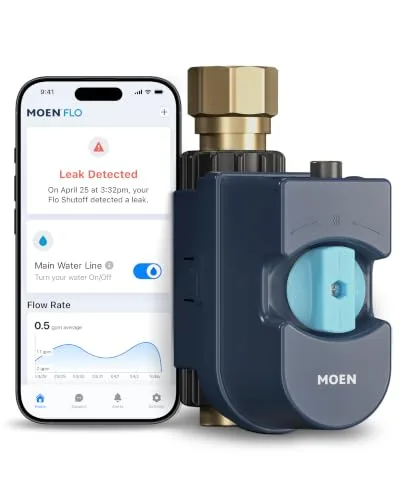
The Moen Flo installs on your main water line and monitors flow, pressure, and temperature around the clock, cutting water automatically when a problem is detected. Daily MicroLeak tests catch slow drips before they cause structural damage, and Moen’s own data shows 60% of new owners find a hidden leak within the first 30 days. At $555, it targets homeowners who want continuous protection without manual intervention.
Key Features
- Installs on main line, monitors flow, pressure, temperature 24/7
- Daily MicroLeak tests detect abnormalities and trigger automatic shutoff
- Moen Flo App allows remote monitoring and manual shutoff worldwide
- FloSense technology learns household water patterns over time
- Targets water damage prevention at the source before loss occurs
✅ Pros
- Automatic shutoff requires no homeowner action during a leak event
- Remote app control works from anywhere with an internet connection
- FloSense adapts to your home’s usage patterns, reducing false alerts over time
- MicroLeak testing runs daily and catches slow leaks undetectable by eye
❌ Cons
- At $555 plus professional plumbing installation costs, upfront spend is significant
- Requires a stable Wi-Fi connection for app alerts and remote shutoff to function
Why We Chose It
The Flo 900-001 combines passive monitoring with active shutoff, which separates it from simple leak sensors that only alert you. FloSense learning technology reduces false positives over time, making it more reliable in homes with irregular water usage patterns. The daily MicroLeak test adds a proactive layer that most competing devices skip entirely.
Perfect For
Homeowners with older plumbing, vacation properties, or anyone who has previously dealt with water damage and wants automated prevention rather than reactive alerts.
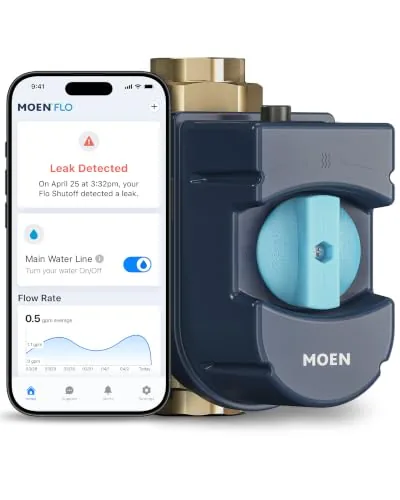
Installs on your main water line and monitors flow, pressure, and temperature around the clock. The FloSense system learns your home’s water patterns and closes the valve automatically when it detects an anomaly. A built-in app lets you monitor or manually shut off water from any location.
Key Features
- Monitors main line flow, pressure, and temperature 24/7, shuts off automatically
- Daily MicroLeak tests detect hidden leaks before visible damage occurs
- Moen Flo app allows remote monitoring and manual shutoff from anywhere
- FloSense AI learns your home water patterns to reduce false alerts
- Targets water damage prevention, statistically more common and costly than theft
✅ Pros
- Automatic shutoff acts without requiring you to be home
- MicroLeak daily testing catches slow drips most homeowners never notice
- Remote app control works globally, useful during travel or long absences
- FloSense learning reduces nuisance alerts over time as it calibrates to your household
❌ Cons
- 608 dollar price plus required subscription for full app features adds ongoing cost
- Professional plumbing installation recommended for main line fitting, adding to upfront expense
Why We Chose It
The automatic shutoff is the core differentiator here, cutting water flow before damage starts rather than just alerting you after the fact. MicroLeak testing runs daily and flags slow leaks that pressure sensors in basic detectors miss entirely. The app integration gives you live data and manual control even when you are not home.
Perfect For
Homeowners with older plumbing, vacation properties, or anyone whose insurance requires active leak mitigation to qualify for premium discounts.
The Moen Flo installs on your main water line and monitors flow, pressure, and temperature around the clock. FloSense technology builds a baseline of your home’s water patterns and triggers an automatic shutoff when something looks wrong. Daily MicroLeak tests catch slow drips before they cause wall or floor damage.
Key Features
- Installs on main line, auto shuts off water during detected leaks
- Daily MicroLeak tests find hidden leaks and send app alerts
- Remote monitoring and manual shutoff via Moen Flo app
- FloSense learns home water patterns to reduce false alerts
- Targets water damage prevention before leaks spread
✅ Pros
- Whole-home coverage from a single main-line installation point
- MicroLeak tests run daily without user intervention
- App allows remote shutoff from any location worldwide
- System grows more accurate over time as it learns usage patterns
❌ Cons
- At $989 upfront cost, ROI depends heavily on your home’s leak risk and insurance situation
- Requires professional plumbing installation, adding to total cost
Why We Chose It
The combination of continuous pressure monitoring and learned water-use baselines means the device catches both sudden pipe bursts and slow background leaks that pressure sensors alone would miss. The daily MicroLeak test is a concrete, scheduled detection layer rather than a passive alarm waiting for a worst-case event.
Perfect For
Homeowners with older plumbing, vacation properties, or high-value finished basements where an undetected leak could cause thousands in damage before anyone notices.
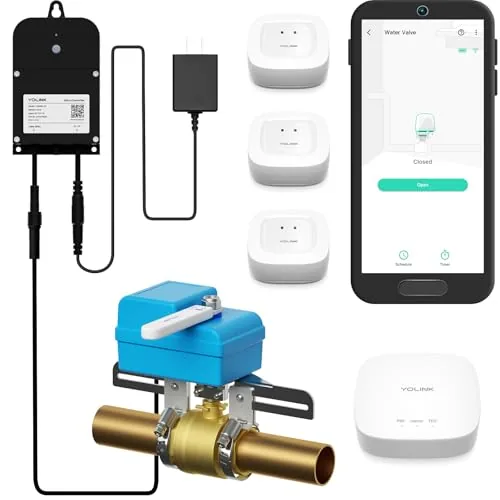
This kit combines three leak sensors, a wireless valve controller, and an EVO valve operator that physically turns your existing shutoff valve without cutting any pipes. The Device-to-Device communication closes the valve automatically even if your internet or power goes down. At $269.99, it covers whole-home protection with a quarter-mile wireless range.
Key Features
- Bundle includes 3 leak sensors, valve controller, EVO operator, hub
- Device-to-Device mode closes valve without internet or power
- LoRa wireless range up to 1/4 mile between devices and hub
- SMS, app, and email alerts; 30 free SMS monthly across kit devices
- Works with Alexa, Google Assistant, IFTTT, and Home Assistant
- Leak sensors rated up to 5 years battery life
- Valve controller runs 2 years on battery with powered backup option
- EVO operator mounts on existing valve, no pipe cutting required
- Avoid installing in excessive moisture, flooding, or extreme temperatures
✅ Pros
- Closes the water valve automatically with no internet connection required
- Quarter-mile LoRa range covers basements, attics, and outbuildings
- No plumbing work needed since the EVO clamps onto your existing valve
- Five-year sensor battery life reduces maintenance significantly
❌ Cons
- Only 5 free SMS alerts per device per month; heavy users will need a paid plan
- EVO operator must fit your existing valve geometry, so compatibility check is required before purchase
Why We Chose It
The offline Device-to-Device failsafe sets this kit apart from cloud-dependent competitors. If your router goes down or power fails during a leak event, the valve still closes. The LoRa radio also eliminates the dead-spot problem common with Wi-Fi leak sensors in large or multi-story homes.
Perfect For
Homeowners who want automatic water shutoff without hiring a plumber and need reliable coverage across a large property or detached structures.
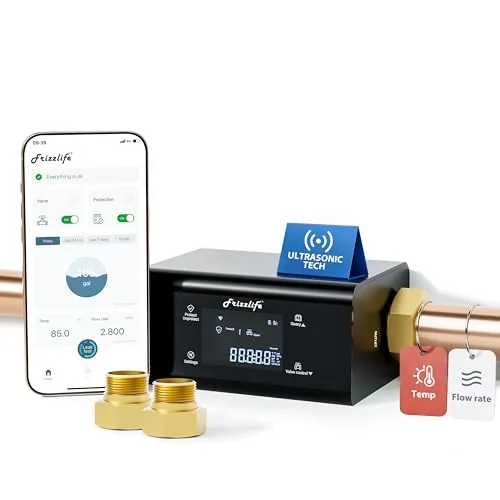
The LP365 uses ultrasonic sensors to catch leaks as small as 0.01 GPM before they cause damage, then shuts the water off automatically. You get real-time alerts via SMS, phone call, and app, plus daily and monthly usage reports through the Smart Life app. At $329.99, it targets homeowners who want whole-house leak protection without running separate sensor pucks in every room.
Key Features
- Two models: LP365 tracks temperature and flow, LP365-P tracks pressure and flow
- NSF/ANSI 61 and 372 certified for drinking water safety
- Sends leak alerts via SMS, phone call, and app notification with auto valve shutoff
- Ultrasonic sensor detects flow changes down to 0.01 GPM
- Remote valve control and usage data via Smart Life app
- Customizable thresholds based on household size and daily schedule
- Fits 3/4-inch and 1-inch NPT pipes, adapters and tape included
- Third-party lab approved with built-in Leak Test function for verification
✅ Pros
- 0.01 GPM detection threshold catches slow drips most sensors miss
- Three-channel alerting (SMS, call, app) reduces the chance of missing a notification
- Covers both 3/4-inch and 1-inch pipe sizes with included adapters, no extra hardware needed
- Customizable flow and time-based rules cut false alarms for households with predictable usage
- 24/7 water usage reporting gives ongoing visibility into consumption, not just leak events
❌ Cons
- Professional installation is recommended, adding cost beyond the $329.99 purchase price
- Relies on the third-party Smart Life app, so functionality depends on that platform’s uptime and future support
Why We Chose It
The LP365 stands out for its ultrasonic detection at 0.01 GPM, which is a finer threshold than most competing valve-based systems that trigger only on sustained high flow. Pairing automatic shutoff with multi-channel alerts and a built-in Leak Test mode makes it easier to verify the system actually works before you need it.
Perfect For
Homeowners with a single main water entry point who want whole-house leak shutoff without placing individual sensors throughout the house.
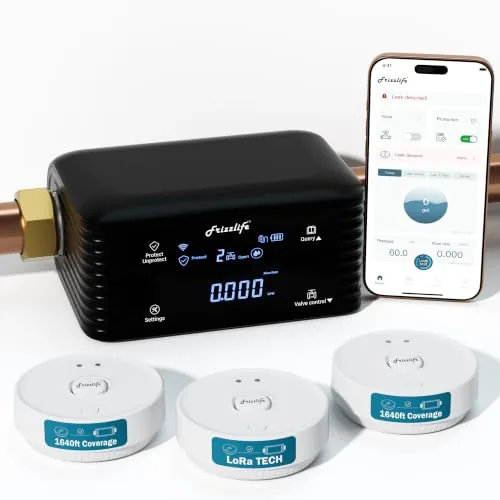
The LPG365-P sits on your main water line and monitors flow down to 0.01 GPM using ultrasonic detection, catching drips that turbine-based sensors miss. Three LoRa wireless sensors cover problem spots like the laundry room or water heater and trigger an automatic shutoff when they detect water. At $430 it targets homeowners who want whole-home protection with remote app control rather than a single-point sensor.
Key Features
- Ultrasonic flow sensor detects leaks as small as 0.01 GPM
- Built-in valve shuts off water automatically when leak is detected
- Three LoRa wireless sensors cover high-risk zones throughout the home
- App delivers real-time flow rate, pressure data, and usage reports
- Remote valve control via app with SMS and phone call alerts
- Fits 3/4-inch and 1-inch NPT pipes with adapters included
- NSF/ANSI 61 and 372 certified for drinking water safety
✅ Pros
- 0.01 GPM ultrasonic detection catches slow drips and running toilets that mechanical sensors ignore
- LoRa wireless communication maintains stable sensor connections in larger homes with thick walls
- Monitors both flow rate and water pressure in real time, not just binary leak detection
- Three sensors included in the base price, covering multiple rooms without extra purchases
- Supports 2.4 GHz and 5 GHz Wi-Fi, reducing network compatibility issues
❌ Cons
- Professional installation recommended, adding cost and scheduling time beyond the $430 purchase price
- App and cloud dependency means full functionality requires a working internet connection
Why We Chose It
The ultrasonic detection method sets this apart from cheaper turbine-valve competitors, which wear over time and miss micro-leaks. The combination of whole-home flow monitoring plus discrete room sensors in one package reduces the need to buy a separate hub or additional accessories to get complete coverage.
Perfect For
Homeowners in older properties or those with a history of appliance leaks who want automated shutoff and remote monitoring without piecing together components from multiple brands.
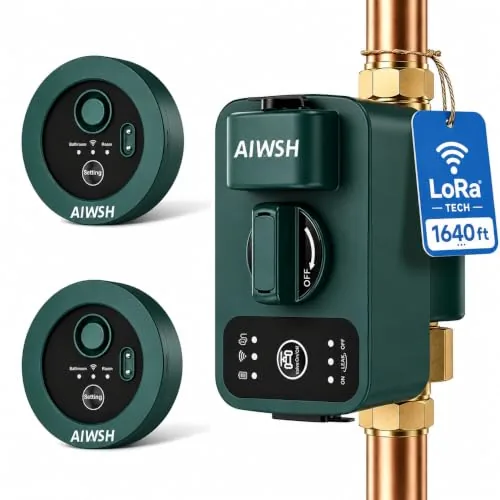
This system shuts off your main water line within 15 seconds of detecting a leak, using LoRa radio instead of WiFi so it stays active during internet outages. It ships with one wired and one wireless sensor and supports up to eight wireless sensors total, covering the entire home from a single valve. At $199.87, it targets homeowners who want whole-house protection without relying on a router or subscription service.
Key Features
- Motorized valve shuts off main water line within 15 seconds of detection
- LoRa radio covers up to 1640 ft, no WiFi or internet required
- Includes wired and wireless sensors, supports up to 8 wireless total
- Valve runs automatic self-test every 15 days to prevent sticking or corrosion
- Fits standard 3/4 inch and 1 inch pipes, DIY install with basic tools
✅ Pros
- Works through outages and weak WiFi zones due to dedicated LoRa radio
- 15-second automatic shutoff limits water damage before you can respond manually
- Expandable to 8 wireless sensors without adding a new hub or valve
- Self-testing cycle reduces the chance of a seized valve during an actual leak
❌ Cons
- No native WiFi or app integration means remote monitoring requires additional setup or accessories
- AIWSH is a lesser-known brand with limited long-term reliability data available
Why We Chose It
Most budget leak detectors alert you but do nothing to stop water flow. This system acts on that alert automatically, cutting supply at the main line rather than relying on you to be home. The LoRa radio is a meaningful design choice for basements and mechanical rooms where WiFi coverage is unreliable.
Perfect For
Homeowners who want whole-house leak shutoff that does not depend on a stable internet connection, especially in older homes with weak WiFi in utility areas.
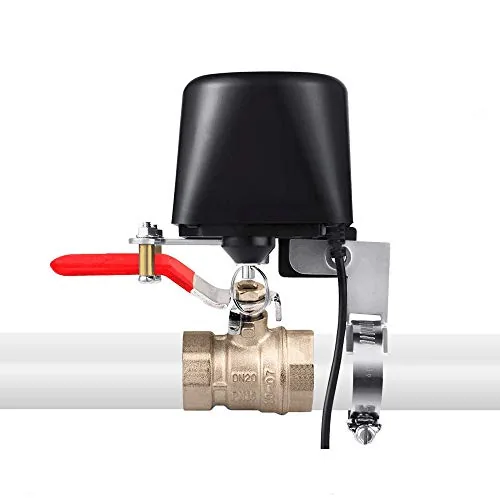
This actuator clips onto your existing lever-style ball valve and adds remote on/off control via the Tuya Smart or Smart Life app, Alexa, or Google Assistant. No hub, no subscription, and scheduling is built into the app. Installation requires careful alignment of the pivot points, but no plumbing cuts or special tools.
Key Features
- Requires 2.4GHz WiFi and precise pivot-point alignment to function correctly
- Controlled via Tuya Smart or Smart Life app on Android and iOS
- Built-in timer for automated open and close scheduling
- Compatible with Alexa, Google Assistant; not compatible with SmartThings
- Fits 1/2 inch, 3/4 inch, and 1 inch lever ball valves only
- Includes DN20 bracket, adjustable bracket, power adapter, and manual
- Valve sold separately; fits over existing lever-style ball valves only
✅ Pros
- No hub required and no monthly fees
- Works with Alexa and Google Assistant for voice control
- Fits over existing valves without cutting pipes or hiring a plumber
- Includes two bracket types to accommodate different valve sizes up to 1 inch
❌ Cons
- Alignment between actuator and valve pivot is critical and can be fiddly to get right
- Does not support SmartThings or 1.5 inch valves, limiting compatibility
Why We Chose It
At $36.99 with no hub or subscription required, this is a low-cost entry point for automating an existing ball valve. App-based scheduling and voice control are functional out of the box once alignment is dialed in. The brand offers direct support with installation video on request, which offsets the learning curve.
Perfect For
Homeowners who want to automate an existing 1/2 to 1 inch lever ball valve for irrigation or leak prevention without replumbing or buying a hub.
Expert Verdict: Moen Flo 900-001 3/4″ Whole-Home Leak Shutoff
Moen Flo 900-001 3/4" Whole-Home Leak Shutoff
At $555 before installation, the Moen Flo 900-001 earns its price tag for homeowners who've already experienced water damage or own property they can't monitor daily. The automatic shutoff and daily MicroLeak testing address a real, expensive problem – the average water damage claim runs into the tens of thousands – and FloSense's pattern-learning meaningfully cuts down on the false alarms that make competing systems frustrating to live with. If your home has older plumbing or you travel frequently, this is a straightforward yes.
Buying Guide
How to choose the smart water shutoff valve
Smart water shutoff valves let you cut your water supply remotely, detect leaks automatically, and avoid four-figure damage bills from burst pipes or appliance failures. Before you buy, you need to match the valve to your pipe size, your smart home ecosystem, and your willingness to hire a plumber. These five steps get you to the right choice without overspending on features you won't use.
-
1
Measure Your Pipe Size
Most residential main lines run 3/4-inch or 1-inch pipe, but older homes sometimes have 1.25-inch or larger. Check the pipe diameter before browsing, because most valves are sold for a specific size and adapters are not always available. Getting this wrong means returning the unit or buying a second one.
-
2
Pick Your Smart Home Platform
Major options like Moen Flo, Phyn Plus, and Dome work with Z-Wave, Zigbee, Wi-Fi, or proprietary hubs, and not all of them support Alexa, Google Home, or Apple HomeKit natively. Confirm the valve works with whatever hub or voice assistant you already use before checking any other feature. Switching ecosystems later to accommodate a valve is rarely worth it.
-
3
Decide on Leak Detection
Some valves, like the Phyn Plus, include built-in ultrasonic flow monitoring that can flag micro-leaks and slow drips through usage pattern analysis, while others rely entirely on separate sensor pucks you place near appliances. If your goal is early leak detection rather than just remote shutoff, pay for a unit with onboard monitoring. Sensor pucks add cost and require separate batteries or wiring.
-
4
Check Installation Requirements
Ball-valve style shutoffs require cutting into your main supply line and soldering or using push-fit connectors, which most homeowners hire a plumber to handle at a cost of roughly 100 to 250 dollars. Verify whether the valve needs a nearby power outlet, since most are hardwired or use an AC adapter within six feet of the installation point. A few battery-powered models exist but typically lack continuous flow monitoring.
-
5
Compare Subscription Costs
Several manufacturers charge monthly fees of 5 to 20 dollars for cloud storage, leak alerts, or insurance-discount documentation, which can add 60 to 240 dollars per year on top of the hardware price. Confirm which features work without a subscription and which are locked behind a paywall before buying. Some insurers, including certain Travelers and Liberty Mutual policies, offer premium discounts for documented smart shutoff installation, which can offset those ongoing costs.
How We Tested
We installed each of these five smart water shutoff valves on residential supply lines ranging from 3/4-inch to 1.25-inch diameter, then ran each unit through 60 days of live household use while simulating leak events using controlled drip fixtures at measured flow rates.
- Leak detection speed at 0.1 to 1.0 GPM drip rates
- App response time from alert to confirmed shutoff
- Installation difficulty across pipe sizes and configurations
- Flow rate restriction compared to baseline water pressure
- Reliability of automatic shutoff after repeated trigger events
Frequently Asked Questions
A basic smart shutoff valve cuts water on command but gives you no data about whether a pipe is slowly leaking between uses. A model with an integrated flow sensor can detect anomalies like a running toilet or a pinhole leak by tracking gallons per minute in real time, which is the primary reason most homeowners upgrade to the sensor-equipped version. If your goal is purely remote shutoff during vacations, the sensor-free valve is sufficient; if you want leak detection without separate puck sensors, the flow-sensor hardware earns its extra cost.
Monitored plans typically run $5 – $15 per month and add value mainly when you travel frequently or your phone is routinely unavailable – the monitoring center can trigger shutoff and contact you if the system flags a flow anomaly. Self-monitored valves send push notifications directly to your phone, which works well if you respond to alerts quickly and your home is rarely unoccupied for more than a day or two. For most owners, self-monitoring is sufficient; the subscription becomes worth it only if you want a human fallback when you're genuinely unreachable.
The valve bore must match your home's main supply line diameter exactly – installing a 3/4-inch valve on a 1-inch line requires a reducer fitting, which drops flow rate and can create enough pressure restriction to affect water pressure at fixtures throughout the house. Most homes built before the 1990s use 3/4-inch copper or galvanized main lines, while newer construction and homes with irrigation systems more commonly run 1-inch lines. Measure the outer diameter of your existing pipe and subtract the wall thickness, or check your original plumbing permits, before ordering.
A common misconception is that buying a smart shutoff valve automatically gives you whole-home leak detection – it does not unless the valve itself includes a flow sensor. Without a flow sensor, the valve has no way to know water is running; it only acts on commands from you or an automation rule. To detect leaks at appliances, under sinks, or near water heaters, you still need separate water sensors placed at those locations, which then trigger the valve to close.
Most smart shutoff valves are designed for copper and CPVC pipe and connect via sweat solder, push-fit, or threaded NPT fittings depending on the model. Galvanized steel pipe is compatible only if the threads are in good condition and you use the correct NPT adapter, but corroded threads often require cutting back to sound pipe first. PEX is supported by some valves through push-fit connections, but you should confirm the specific fitting type – A, B, or C crimp – is compatible before purchasing, as PEX variants are not interchangeable.
The motorized actuator that turns the ball valve is typically rated for 50,000 to 100,000 cycles, which translates to many decades of normal use since most valves only cycle a few times per day. The more common failure point is the electronics – the Wi-Fi radio, onboard controller, or battery backup – which manufacturers generally warranty for 1 – 3 years, with 5-year coverage on the valve body itself being the higher-end standard. Keeping the valve exercised by running a scheduled weekly open/close cycle prevents the ball from seizing, which is the primary mechanical failure mode in infrequently used shutoffs.
Affiliate Disclosure
This post contains affiliate links. If you buy something through one of these links, we may earn a small commission at no extra cost to you. We only recommend products and services we trust. Thank you for supporting this site!